
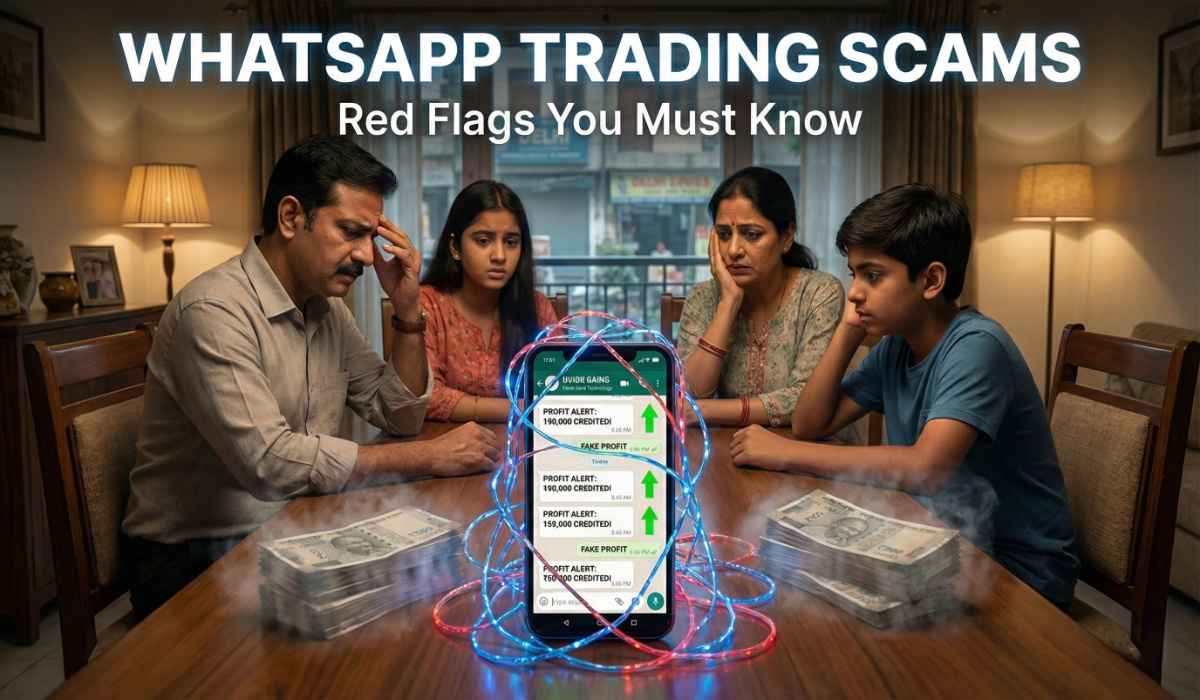
Trading scams are exploding across India, and you could be next.
Over 30,000 Indians lost ₹1500 crore to fake trading app scams in 2025, with most victims getting trapped through innocent-looking WhatsApp messages. If you’re someone who’s received investment “tips” on WhatsApp, downloads trading apps, or considers online investment opportunities, you need to know these red flags before you lose your hard-earned money.
This guide is for everyday investors, first-time traders, and anyone who wants to protect themselves from fake trading app scams India. You’ll learn how fraudsters use WhatsApp trading group fraud to hook victims, the specific warning signs that reveal fraudulent investment platforms India, and a step-by-step protection plan that works whether you’re a complete beginner or an experienced investor.
We’ll break down how these scammers operate through WhatsApp groups, show you the exact red flags that expose fake trading apps, and give you a bulletproof checklist to verify any investment platform before you risk a single rupee.
How Fake Trading Apps Lure Victims Through WhatsApp Groups

Promise of guaranteed high returns and expert trading tips
Fake trading apps in India primarily hook victims by making unrealistic promises that prey on your desire for quick wealth. These fraudulent platforms typically promise to double or triple your money within short timeframes, far exceeding the stock market’s realistic annual returns of 12% to 15% over three to five years. When you encounter guarantees of extraordinary profits with minimal risk, you’re looking at a major red flag that should immediately raise your suspicions.
The scammers present themselves as expert traders or financial professionals, often using fake credentials from reputable investment banks. In documented cases, fraudsters have impersonated managers from well-known institutions like Barclays Investment Bank to build credibility with potential victims. They position themselves as having insider knowledge or special trading strategies that can generate consistent high returns, appealing to your greed and desire for financial success.
Use of fake testimonials and success stories from supposed investors
Once you’re drawn in by the initial promises, these fake trading apps rely heavily on manufactured social proof to convince you that their platform delivers results. The scammers create elaborate WhatsApp groups filled with accomplices who regularly share screenshots of supposed earnings and fabricated profit statements. These fake group members continuously post about their trading successes, creating an illusion that everyone in the group is making substantial profits.
In real documented cases, victims have seen profit statements showing earnings of ₹14 crore, all completely fabricated to maintain the illusion. These testimonials are carefully crafted to look authentic, often including realistic-looking trading dashboards and withdrawal confirmations. The psychological impact of seeing multiple “successful investors” sharing their wins creates a powerful sense of legitimacy that makes you more likely to trust the platform with your money.
Creation of exclusive groups with limited-time investment opportunities
The scammers enhance their credibility by creating seemingly exclusive WhatsApp groups with professional names like ‘CATALIST CUSTOMER SERVICE’ or ‘India Stock HUB12’. These groups are designed to make you feel like you’re part of an elite investing community with access to special opportunities not available to the general public. The exclusivity factor plays on your fear of missing out on profitable investments.
Within these groups, the fraudsters share what appear to be real-time market tips and analysis, complete with professional-looking charts and technical indicators. They create an environment where investment opportunities seem urgent and time-sensitive, making you feel privileged to have access to such “valuable” information. This exclusivity helps build trust and makes you more receptive to their investment proposals.
Pressure tactics to invest quickly before missing out
The final manipulation tactic involves creating artificial urgency to push you into making hasty investment decisions. Scammers use phrases like “limited-time opportunity” or “spots are filling up fast” to create psychological pressure. They often claim that market conditions are perfect for immediate investment, suggesting that any delay could result in missed profits.
To build initial trust, some fraudulent platforms even allow small withdrawals from early investments, as documented in cases where victims received payouts of ₹90,000 on initial investments of ₹3.5 lakh. This calculated move is designed to prove the platform’s legitimacy and encourage you to invest larger amounts. Once you’re convinced and make substantial investments, the scammers disappear, leaving you unable to withdraw your funds and often demanding additional “withdrawal taxes” to access your supposed profits.
Red Flags That Reveal Fraudulent Trading Platforms
Unregistered apps not available on official app stores
When you’re evaluating a trading platform, one of the first red flags you should watch for is the absence of the app from legitimate app stores like Google Play Store or Apple App Store. Fraudulent trading platforms often avoid these official channels because they cannot meet the stringent security and compliance requirements these stores demand.
Scammers typically distribute their apps through direct download links shared in WhatsApp groups or through suspicious websites. This bypassing of official app stores should immediately raise your suspicion, as legitimate trading platforms always ensure their apps are available through proper channels. Official app stores conduct thorough security checks and verify the authenticity of developers, making it much harder for fraudulent apps to gain approval.
Lack of proper SEBI registration and regulatory compliance
Now that we understand the distribution red flags, the next critical warning sign involves regulatory compliance. You must verify that any trading platform you consider is properly registered with SEBI (Securities and Exchange Board of India) and other relevant regulatory authorities.
Legitimate trading platforms operating in India are required to maintain proper licensing and regulatory compliance. When you encounter offshore retail brokers that aren’t regulated by recognized authorities like the CFTC, NFA, or their nation of origin, you should exercise extreme caution. Some fraudulent firms have been known to pack up and disappear with clients’ money when confronted about their regulatory violations.
The practice of fund commingling represents another serious compliance issue. Without proper segregated accounts, you cannot be certain that your funds aren’t being misused inappropriately, such as for paying exorbitant salaries, luxury expenses, or worse – complete disappearance with your investment.
Unrealistic profit promises and guaranteed returns claims
With regulatory compliance in mind, the next major warning sign involves the promises these platforms make to you. You should be extremely skeptical of any promotional material that guarantees high levels of performance or unrealistic returns. Legitimate trading involves inherent risks, and no genuine platform can guarantee consistent profits.
Signal sellers often perpetuate this type of scam by offering systems that claim to identify favorable trading opportunities for daily, weekly, or monthly fees. These individuals or companies typically boast about their vast trading experience and unique abilities, presenting long lists of positive testimonials from supposed successful users. However, many of these services have never submitted their systems for formal review or had their performance claims verified by independent parties.
Poor app quality with frequent crashes and technical issues
Previously, we’ve covered the regulatory and promotional red flags, but technical performance issues represent equally important warning signs. When you encounter problems within the trading platform itself, such as inability to enter or exit trades during volatile market conditions or after economic announcements, these should trigger immediate concern.
You should pay particular attention to whether you can withdraw your funds from investor accounts without issues. If you experience difficulties withdrawing money or notice that the trading platform doesn’t operate according to your liquidity expectations, these are serious warning signs that demand your immediate attention.
Frequent crashes, slow response times, and overall poor app quality often indicate that the platform lacks the professional development and infrastructure investment that legitimate trading platforms possess. These technical shortcomings may also be deliberate tactics used to prevent you from executing trades at optimal times or withdrawing funds when desired.
The Anatomy of India’s ₹1500 Crore Trading Scam Network

International connections linking fraudsters to China and Cambodia
When you examine the structure of India’s ₹1500 crore trading scam network, you’ll discover that these operations extend far beyond Indian borders. The Ministry of Home Affairs has identified that several scam networks are linked to foreign syndicates, particularly those operating from China and Cambodia. These international connections enable fraudsters to coordinate sophisticated operations that target Indian investors through fake trading apps and WhatsApp investment scams.
The cross-border nature of these scams makes them particularly challenging to investigate and prosecute. Your money, once transferred to these fraudulent platforms, often gets routed through multiple international channels, making recovery extremely difficult.
How 30,000 Indians became victims of coordinated fraud schemes
The scale of victimization reveals the coordinated nature of these fake trading app scams. Over 30,000 Indians have fallen prey to investment scams in just six months, with your fellow citizens in Bengaluru, Delhi-NCR, and Hyderabad bearing the brunt of these attacks. These three metropolitan areas alone account for nearly 65% of all reported cases.
What makes these schemes particularly devastating is their targeting strategy. If you’re aged between 30 to 60, you’re in the prime demographic that fraudsters focus on, representing 76% of all victims. The scammers specifically target this group because of your financial aspirations and disposable income. Even if you’re above 60, you’re not immune – 8.62% of victims (approximately 2,829 people) are senior citizens.
The average loss per victim stands at a staggering ₹51.38 lakh, indicating that these aren’t opportunistic small-scale frauds but sophisticated operations designed to extract maximum value from each target.
Role of fake customer support and withdrawal manipulation tactics
The fraudulent trading platforms you encounter employ sophisticated customer support facades to maintain the illusion of legitimacy. These fake customer support systems are designed to keep you engaged and confident in the platform while preventing you from accessing your funds when you attempt withdrawals.
The withdrawal manipulation tactics form a crucial part of the scam anatomy. Initially, you might be allowed to withdraw small amounts to build trust, but when you attempt to withdraw larger sums or your principal investment, you’ll encounter various obstacles and excuses designed to delay or prevent access to your money.
Money laundering methods used to siphon funds abroad
The money laundering component of these trading app fraud schemes is particularly sophisticated. Once your funds are collected through fake trading apps and WhatsApp trading group fraud, the money gets channeled through complex international networks. The reference to foreign syndicate connections indicates that your invested money is likely being siphoned out of India through various laundering methods.
These methods typically involve multiple layers of transactions across different countries, making it nearly impossible for you to trace or recover your funds. The international nature of these operations, particularly the links to China and Cambodia, provides the fraudsters with jurisdictional advantages that complicate law enforcement efforts.
The Indian Cyber Crime Coordination Centre (I4C) is actively collaborating with state cyber units to track these fund trails, but the sophisticated nature of these money laundering operations continues to pose significant challenges for recovery efforts.
For Beginners

The Lure: You Are Randomly Added to a WhatsApp Group with “Experts”
Your phone buzzes with a notification – you’ve been added to a WhatsApp group called “Stock Market Millionaires” or “Crypto Elite Investors.” The group has 200+ members and features impressive profile photos of supposed financial experts. You see messages flooding in about incredible trading opportunities and screenshots of massive profits. These aren’t coincidences – you’ve become a target for fake trading app scams India operators who carefully craft these scenarios.
The scammers behind these WhatsApp trading group fraud schemes don’t randomly select victims. They purchase phone numbers from data brokers or harvest them from social media platforms. Your number gets added to multiple investment-focused groups simultaneously, creating an illusion of organic discovery. The group admins post testimonials, market analysis, and success stories designed to build credibility and trigger your fear of missing out.
The Hook: You Are Convinced to Download a Special Trading App
After days of observing “expert” discussions and profit screenshots, you receive a direct message from a group admin. They offer you exclusive access to their “private trading platform” that’s supposedly unavailable to the general public. You’re told this app uses advanced algorithms and insider information to guarantee profits.
The download link they share bypasses official app stores completely. Instead of directing you to Google Play Store or Apple App Store, you’re asked to enable “unknown sources” and install an APK file directly. This is a massive red flag that most beginners miss. Legitimate trading platforms always distribute their apps through official channels and maintain proper security certifications.
These fraudulent investment platforms India scammers create convincing app interfaces that mimic established brokers like Zerodha or Upstox. The fake apps display real-time market data to appear authentic, but your actual trades never reach any legitimate exchange. Everything you see is manipulated data designed to hook you deeper into their scheme.
The “Profit”: The App Shows Illusory Growth
Once you’ve deposited your initial investment – often starting small with ₹5,000 to ₹10,000 – the magic begins. Your portfolio shows incredible growth within hours or days. Stock picks recommended by the WhatsApp group “experts” seem to skyrocket exactly as predicted. Your ₹10,000 investment might show as ₹25,000 within a week, creating an addictive rush of excitement.
This fabricated success is purely psychological manipulation. The scammers know that showing you losses initially would make you withdraw immediately. Instead, they let you “win” to build confidence and encourage larger deposits. You start sharing your success with friends and family, inadvertently becoming a promoter of their scam.
The fake trading app’s interface is designed to feel legitimate, complete with charts, market news, and professional-looking dashboards. However, none of your money actually gets invested in real markets. Your displayed profits exist only as numbers on their manipulated server, not as actual assets you own.
The Trap: When You Try to Withdraw, the App Blocks It
The moment of truth arrives when you decide to withdraw some profits to test the platform’s legitimacy. Perhaps you want to take out your initial investment plus some gains, feeling confident about the app’s performance. This is when the fake trading app scam warning signs become impossible to ignore.
Your withdrawal request gets “processed” for days without any money reaching your bank account. Customer support responds with vague explanations about “technical difficulties” or “verification procedures.” Then comes the devastating demand – you must pay additional fees, taxes, or “unlock charges” before accessing your funds.
These criminals might claim you owe 18% GST on your profits, or demand a “security deposit” equal to 20% of your withdrawal amount. They create official-looking tax certificates and government notices to legitimize these fraudulent demands. Each payment you make to “unlock” your funds only feeds their scam further, while your actual money remains permanently trapped in their fake system.
The psychological pressure intensifies as they show you exactly how much money you’re “losing” by not paying these fees. They might even offer limited-time discounts on the unlock charges to create urgency. Every excuse they provide sounds reasonable enough to keep you hoping, but your money is already gone – transferred through multiple accounts and converted to cryptocurrency within hours of your initial deposit.

1. Is the app on the official Google Play / Apple App Store? If not, it’s a 99% red flag.
Before you even think about downloading any trading app, check if it’s available on legitimate app stores. Fake trading apps often ask you to download APK files directly from their websites or third-party sources. This should immediately set off alarm bells.
When scammers create fraudulent apps, they can’t get them approved on official platforms because Google and Apple have strict verification processes. So they resort to hosting these apps on their own servers or sketchy download sites. You’ll often hear phrases like “download our exclusive app” or “get early access by downloading directly from our website.”
Red flag indicators:
- App asks you to enable “unknown sources” on Android
- Download links lead to random websites instead of Play Store/App Store
- App isn’t found when you search directly in official stores
- They claim their app is “too advanced” for regular app stores
2. Is the broker SEBI-registered? Verify their registration number on the official SEBI website.
Your next step involves checking the broker’s credentials with India’s Securities and Exchange Board. Every legitimate broker must have a SEBI registration number, and you can verify this information directly on SEBI’s website at sebi.gov.in.
Don’t just take their word for it when they claim to be registered. Fake trading apps often display fake registration numbers or use numbers that belong to other legitimate companies. The verification process takes less than five minutes and could save you from losing thousands of rupees.
How to verify:
- Visit the official SEBI website
- Look for “Intermediaries/Market Infrastructure Institutions” section
- Search using the broker’s name and registration number
- Cross-check all details including company name and address
Many scam victims later discovered that the “SEBI numbers” shown on fake apps were either completely fabricated or belonged to different, unrelated financial institutions.
3. Does it promise guaranteed or unrealistic returns? A universal red flag.
Real trading involves risk, period. When you see promises like “guaranteed 30% monthly returns” or “risk-free profits,” you’re looking at a scam. No legitimate broker can promise guaranteed returns because market conditions change constantly.
Watch out for language that makes investing sound like a sure thing. Phrases like “foolproof strategy,” “100% success rate,” or “never lose money” should make you run in the opposite direction. Even the most successful traders experience losses regularly.
Warning phrases to avoid:
- “Guaranteed daily profits”
- “Zero risk investment”
- “Secret trading algorithms”
- “Make ₹50,000 per day easily”
4. Are payments made to a personal UPI ID or bank account? Legitimate brokers only accept funds via official, SEBI-compliant channels.
Pay close attention to where your money goes when you make deposits. Legitimate brokers use official payment gateways and their funds go directly into segregated client accounts managed by registered depositories.
Fake trading apps often ask you to transfer money to personal bank accounts or UPI IDs. You might see payment requests to names like “Raj Kumar” or “Trading Solutions Pvt Ltd” instead of the actual registered broker name. This happens because scammers can’t set up proper merchant accounts due to their fraudulent nature.
Legitimate payment methods include:
- Official payment gateways (Razorpay, Payu, etc.)
- Direct bank transfers to registered broker accounts
- Payments processed through recognized clearing corporations
Red flags in payments:
- Personal UPI IDs (@paytm, @phonepe)
- Individual bank account names
- Cryptocurrency payments only
- Cash deposits or informal transfer methods
Always verify that payment recipient names match exactly with the registered broker entity before transferring any funds.
Warning Signs in Communication and Investment Process
Requests for Upfront Fees, Taxes, or Processing Charges
One of the most glaring red flags in fake trading app scams is when platforms demand upfront payments under various pretexts. Fraudulent trading platforms often request money for “processing charges,” “verification fees,” or “tax clearances” before allowing you to withdraw your supposed profits. Legitimate trading platforms never require such payments from your pocket – all fees are typically deducted from your account balance or trading profits directly.
These scammers create elaborate stories about government regulations or platform policies that supposedly mandate these payments. You might receive messages claiming that you need to pay a certain percentage as “tax” to comply with Indian regulations or “processing fees” to activate your withdrawal capabilities. This is a clear manipulation tactic designed to extract more money from victims who have already invested their hard-earned savings.
Inability to Withdraw Profits or Principal Amount
When you attempt to withdraw your money from a fraudulent trading platform, you’ll encounter systematic obstacles and excuses. The platform may show impressive profits on your dashboard, but when it comes to actual withdrawals, various technical issues suddenly emerge. You might face delayed processing times, system maintenance notifications, or requirements for additional documentation that seems never-ending.
Scammers often use this tactic to buy time while they continue to solicit more investments from other victims. They may promise that withdrawals will be processed “soon” or after completing certain verification steps, but the reality is that your money has already been diverted to the fraudsters’ accounts.
Constant Pressure to Invest More Money for Higher Returns
Fraudulent platforms and their representatives maintain relentless pressure on you to increase your investment amounts. They often present time-sensitive opportunities or claim that larger investments will unlock “VIP” status with guaranteed higher returns. This pressure typically intensifies through WhatsApp messages, phone calls, and even personal meetings with supposed “investment advisors.”
The scammers create artificial urgency by claiming that market conditions are perfect for immediate action or that special promotional rates are about to expire. They may also use social proof tactics, sharing fake testimonials or screenshots of other investors’ supposed massive returns to convince you to invest more.
Lack of Transparent Communication About Company Details
Legitimate trading platforms provide clear, accessible information about their company registration, regulatory compliance, and physical addresses. Fake trading apps deliberately obscure these critical details or provide vague, unverifiable information. When you ask specific questions about the company’s background, licensing, or regulatory status, you’ll receive evasive responses or be redirected to irrelevant marketing materials.
The communication from these fraudulent platforms often lacks professional standards and contains inconsistent information about their operations, team members, or business model. This opacity is intentional, as transparency would expose their fraudulent nature and allow potential victims to conduct proper due diligence.
How to Protect Yourself from Trading App Scams
Verify app legitimacy through SEBI and official regulatory channels
Your first line of defense against fake trading app scams is to verify any platform’s legitimacy through official regulatory channels. SEBI has established specific tools to help you verify the registration status of investment intermediaries before you invest your money. Use SEBI’s official “SEBI Check” platform and the Saarthi app to confirm that any trading app or investment platform is registered with the regulator.
When evaluating trading apps, ensure you only use genuine applications from SEBI-registered entities. The regulator has called for verified labeling on legitimate trading apps to help you distinguish regulated platforms from fraudulent ones. Look for official SEBI registration numbers and verify these through the regulator’s official website.
For payment verification, always transact through validated UPI handles that are identifiable by the “@valid” tag. This ensures your payments are directed to authentic financial operators rather than fraudulent accounts set up by scammers.
Research company background and check for proper licensing
Before investing through any platform, conduct thorough research on the company’s background and licensing status. Check the official SEBI website to maintain a list of registered advisors and firms. Verify that the investment advisor or firm holds proper registration with relevant regulatory authorities.
Look for transparency in company information – legitimate platforms will readily provide detailed information about their operations, licensing, and regulatory compliance. Be wary of platforms that are unwilling to provide comprehensive details about their registration status or regulatory oversight.
SEBI has recommended that only SEBI-registered entities should be permitted to market investment products online, making verification of proper licensing crucial for your financial safety.
Never invest based solely on WhatsApp group recommendations
WhatsApp group recommendations have become a primary vehicle for trading app scams, with scammers using these platforms to push fake investment opportunities. Never make investment decisions based solely on recommendations from WhatsApp groups, especially from unknown contacts or recently joined groups.
Scammers often create fake profiles and share fabricated testimonials and success stories to gain your trust within these groups. They may present themselves as successful traders or financial experts, but these personas are carefully crafted to deceive potential victims.
Be particularly cautious of unsolicited investment offers that arrive through WhatsApp messages or group invitations. These platforms have become sophisticated breeding grounds for fraudulent schemes that promise high returns with little or no risk.
Report suspicious activities to cyber crime authorities immediately
If you encounter suspicious trading apps or fraudulent investment schemes, report them immediately to cyber crime authorities. SEBI encourages the public to report suspected investment scams to help protect other potential victims and assist in regulatory enforcement actions.
When you identify potential scams, cease all communication with the suspected scammers and document any evidence of fraudulent activity. Report incidents to SEBI directly or through local police cyber crime units. Prompt reporting increases the chances of preventing further victims and may assist in fund recovery efforts.
The regulator has intensified its campaign against fake trading apps and fraudulent financial promotions, but your active participation in reporting suspicious activities strengthens these protective measures for the entire investor community.

The ₹1500 crore trading scam that affected 30,000 Indians serves as a stark reminder of how sophisticated fraudsters have become in exploiting investors through fake trading apps and WhatsApp groups. By recognizing the warning signs we’ve discussed—from unsolicited investment invitations to platforms lacking proper regulatory credentials—you can protect yourself from becoming the next victim. Remember, legitimate investment opportunities don’t come through random WhatsApp messages promising guaranteed returns.
Your financial security depends on thorough due diligence and skepticism toward too-good-to-be-true offers. Always verify trading platforms through official regulatory websites, never share personal banking details with unverified sources, and trust your instincts when something feels off. If you encounter suspicious trading apps or WhatsApp groups, report them immediately to authorities and warn others in your network. Stay vigilant, stay informed, and remember that protecting your hard-earned money is always worth the extra effort of verification.
Also Read: Lost Money to Online Fraud? Take These 3 Steps First
Disclaimer: This article is published for educational and investor awareness purposes only and does not constitute financial, investment, or legal advice. The information shared is based on publicly available reports and general scam patterns observed in India. Confirm all investment platforms independently through SEBI and official regulatory sources before investing any money. The author and publisher are not responsible for any financial loss arising from actions taken based on this content.