

I’ve been diving deep into ChatGPT prompts for Indian stock research as we head into 2026, and I want to share what I’ve learned with fellow retail investors, financial analysts, and anyone serious about making smarter investment decisions in the Indian markets.
The landscape of stock research is changing fast. AI-powered stock research India is becoming the new normal, and I’ve discovered that the right prompts can transform how you analyze everything from fundamental analysis ChatGPT prompts to complex sector-specific stock research prompts.
In this guide, I’ll walk you through my tested collection of prompts that have helped me streamline Indian stock market analysis 2026 strategies. First, I’ll share the essential prompts I use for fundamental analysis – the ones that dig into company financials, competitive positioning, and growth prospects with laser focus. Then, I’ll show you my advanced technical analysis AI prompts that help decode chart patterns and market movements like a pro.
Finally, I’ll cover the market sentiment analysis techniques I rely on to gauge investor mood and timing. These aren’t just theoretical prompts – they’re the actual ones I use for portfolio management AI tools and regulatory impact analysis India stocks that have shaped my investment approach.
Essential ChatGPT Prompts for Fundamental Stock Analysis
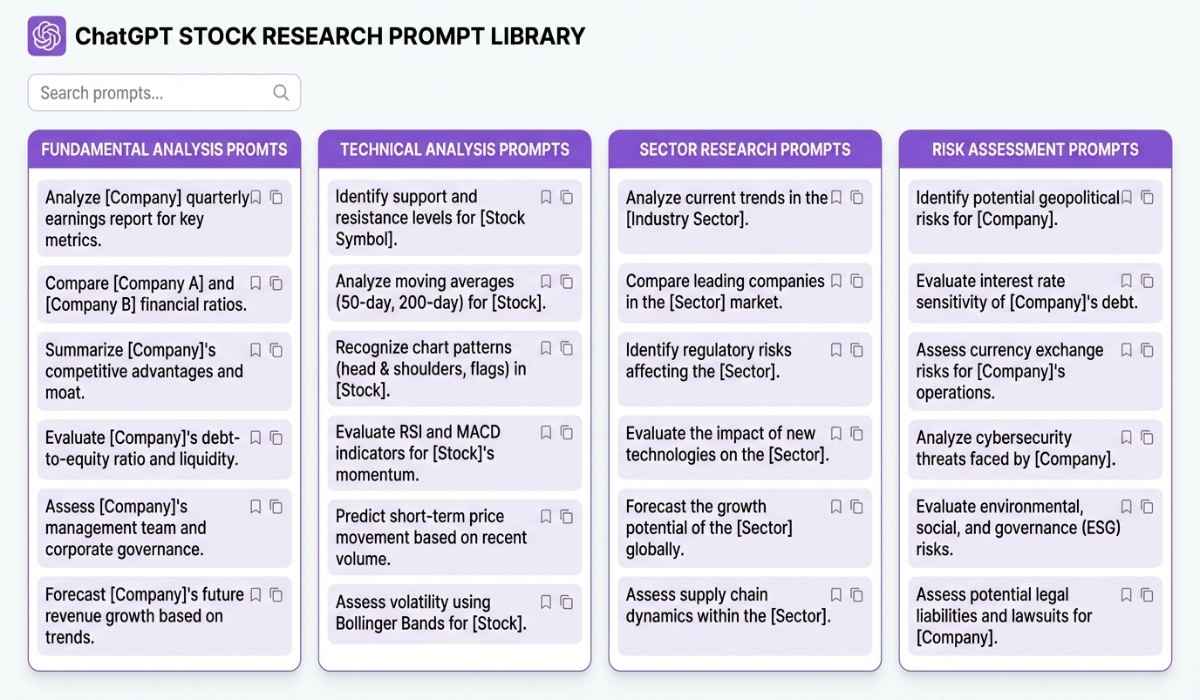
Extract Key Financial Ratios from Annual Reports Instantly
I’ve found that manually sifting through dense annual reports to extract financial ratios can eat up hours of my research time. My go-to ChatGPT prompts for stock research have revolutionized how I analyze Indian companies’ financial health in minutes rather than hours.
My favorite prompt for this task is: “Analyze the financial statements of [Company Name] from their latest annual report. Extract and calculate the following key ratios: P/E, P/B, ROE, ROA, Debt-to-Equity, Current Ratio, Quick Ratio, and Interest Coverage Ratio. Present them in a table format with industry benchmarks for comparison.”
I also use this detailed version when I need deeper insights: “From [Company Name]’s annual report, extract financial data for the past 3 years and calculate trend analysis for profitability ratios (Gross Margin, Operating Margin, Net Margin), efficiency ratios (Asset Turnover, Inventory Turnover), and leverage ratios. Highlight any concerning trends.”
The beauty of these prompts lies in their ability to standardize my analysis across different companies, making my Indian stock market analysis 2026 research more consistent and reliable.
Generate Comparative Analysis Between Competing Companies
Creating side-by-side comparisons of competing companies used to be my biggest research bottleneck. Now I rely on structured prompts that deliver comprehensive competitive analysis in one go.
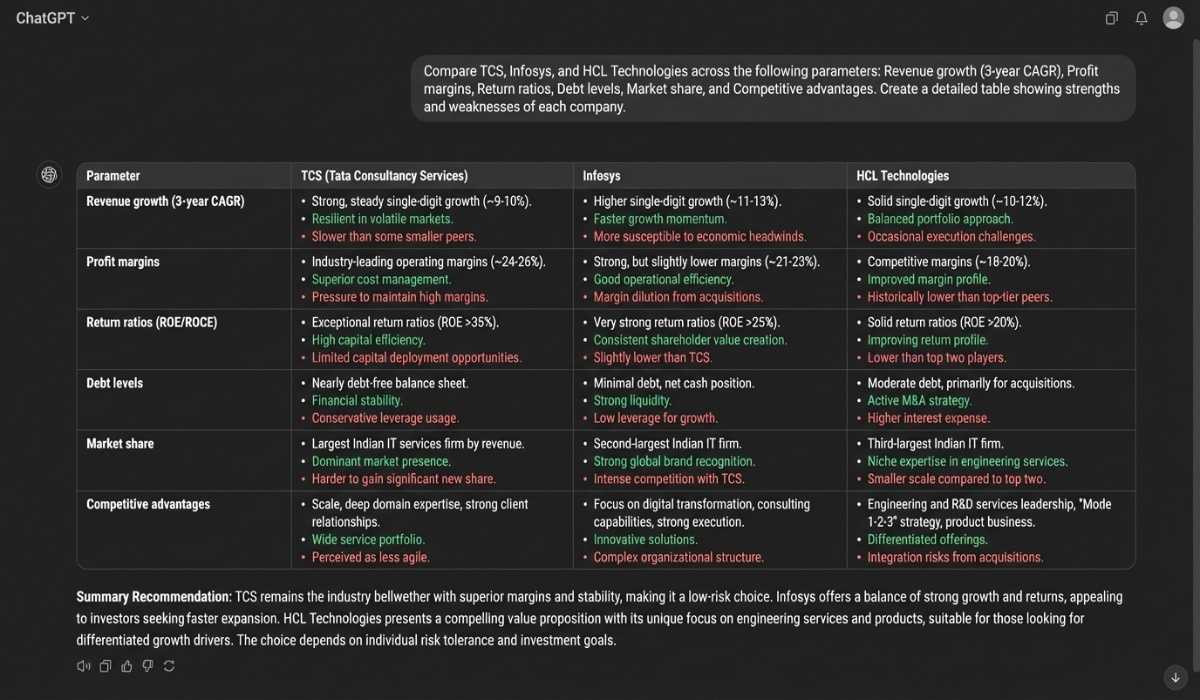
My standard comparison prompt reads: “Compare [Company A] and [Company B] across the following parameters: Revenue growth (3-year CAGR), Profit margins, Return ratios, Debt levels, Market share, and Competitive advantages. Create a detailed table showing strengths and weaknesses of each company.”
For sector-specific comparisons, I use: “Analyze the top 3 players in the [specific sector] – [Company 1], [Company 2], and [Company 3]. Compare their financial metrics, market position, recent performance, and growth prospects. Rank them based on investment attractiveness with reasoning.”
This approach has transformed how I evaluate investment opportunities, especially when I’m torn between similar companies in the same sector.
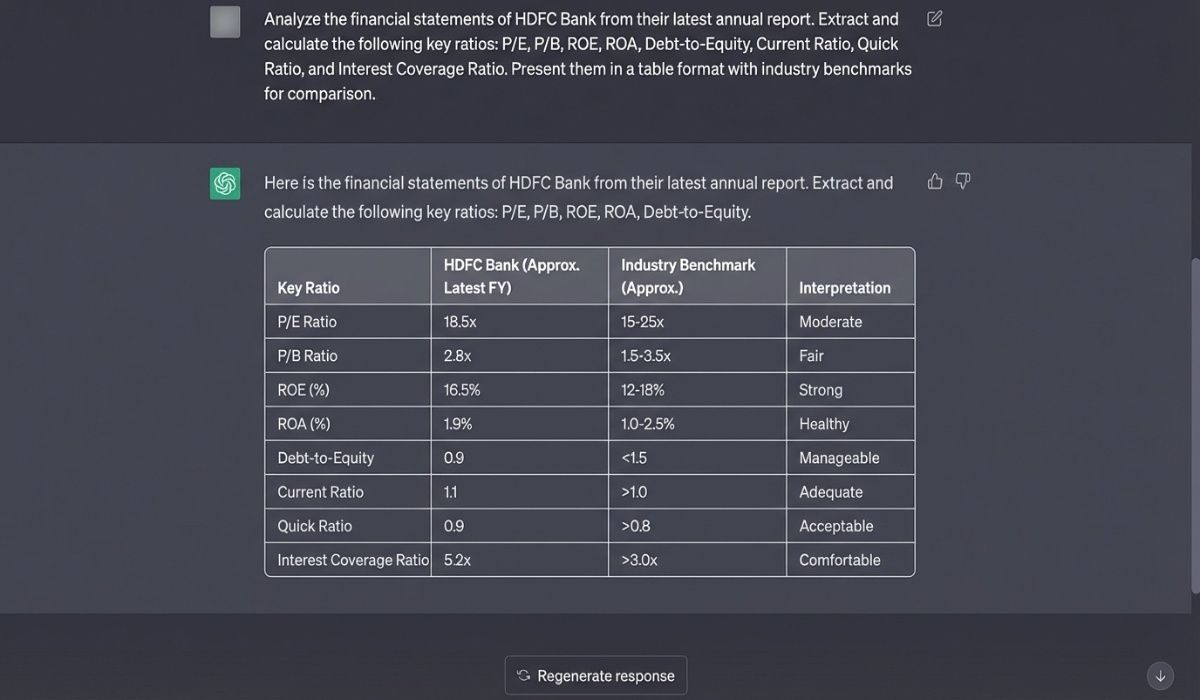
Identify Red Flags in Financial Statements Automatically
My AI-powered stock research India toolkit includes several prompts designed to catch red flags that might slip past during manual analysis. These automated checks have saved me from several potential investment mistakes.
I use this comprehensive red flag scanner: “Review [Company Name]’s financial statements for the past 3 years and identify potential red flags including: Declining cash flows while profits increase, Rising receivables faster than sales, Frequent auditor changes, Unusual one-time gains, High related-party transactions, and Deteriorating working capital. Provide specific examples and severity assessment.”
For management quality assessment, I rely on: “Analyze [Company Name]’s management commentary, corporate governance practices, and historical guidance accuracy. Flag any concerns regarding transparency, executive compensation, insider trading, or strategic decision-making patterns.”
Calculate Intrinsic Stock Valuations with Step-by-Step Reasoning
Valuation calculations often involve complex models that can be prone to errors. My fundamental analysis ChatGPT prompts break down intrinsic value calculations into digestible steps.
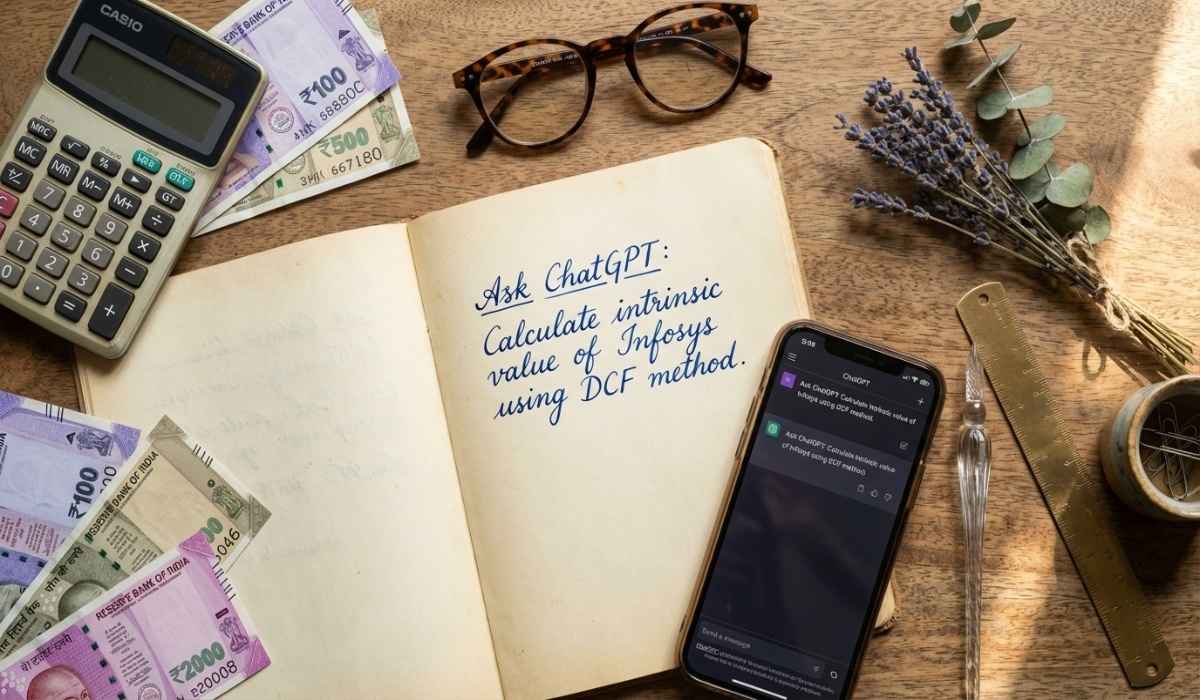
My primary valuation prompt is: “Calculate the intrinsic value of [Company Name] using DCF method. Use the following inputs: Current Free Cash Flow, Growth rates for next 5 years, Terminal growth rate of 3%, and WACC of [X]%. Show detailed calculations for each year and explain assumptions. Also provide sensitivity analysis for different growth scenarios.”
For multiple valuation approaches, I use: “Value [Company Name] using three methods: DCF, P/E multiple method, and P/B multiple method. Compare results with current market price and provide buy/hold/sell recommendation with price targets. Explain which method is most appropriate for this company and why.”
These structured approaches ensure I don’t miss critical steps in my valuation process and can easily adjust assumptions based on changing market conditions or company fundamentals.
Advanced Prompts for Technical Analysis and Chart Reading
Analyze price patterns and trend formations effectively
When I’m diving deep into chart patterns, I’ve found that technical analysis AI prompts can transform how I interpret price movements in Indian stocks. My go-to approach starts with asking ChatGPT to identify specific patterns like head and shoulders, double tops, or triangular formations on stocks I’m tracking.
Here’s how I structure my pattern analysis prompts:
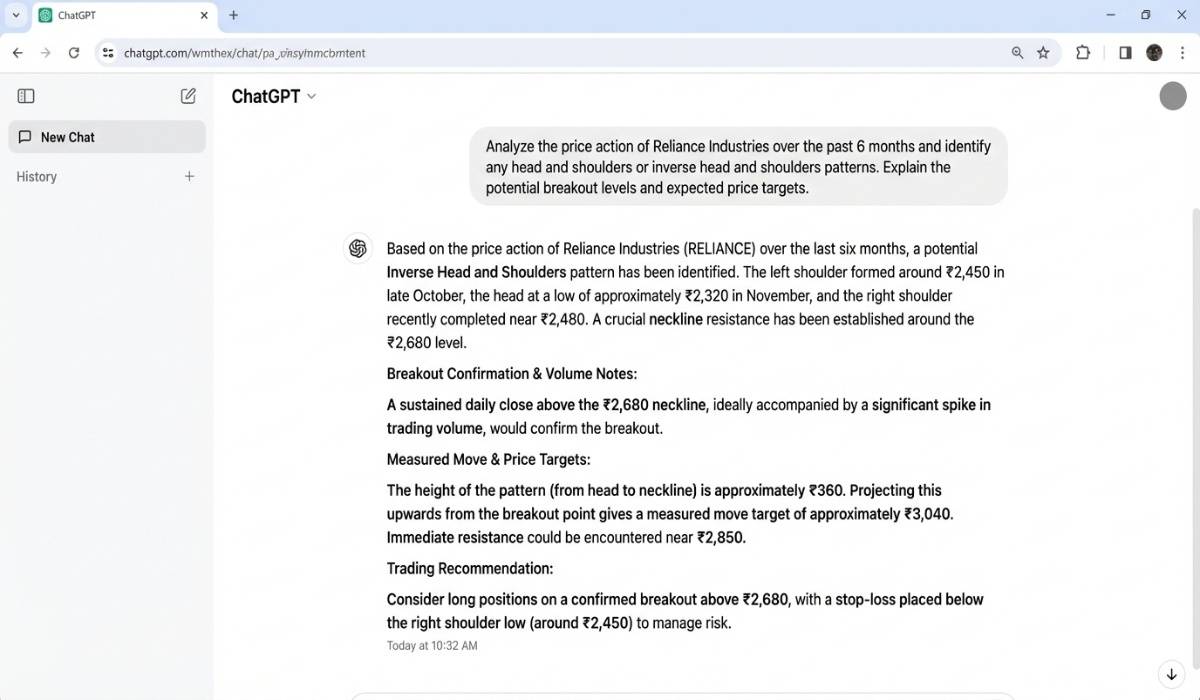
“Analyze the price action of [Stock Name] over the past 6 months and identify any head and shoulders or inverse head and shoulders patterns. Explain the potential breakout levels and expected price targets.”
“Examine the current trend structure of [Stock Name]. Is it forming an ascending triangle, descending triangle, or symmetrical triangle? What are the key breakout points?”
“Identify cup and handle patterns in [Stock Name]’s daily chart. Calculate the pattern’s depth and predict the measured move target.”
I’ve discovered that asking ChatGPT to explain the psychology behind each pattern adds tremendous value. For instance, when I prompt: “Explain why a double bottom pattern in Reliance Industries suggests bullish sentiment and how institutional buying typically occurs at these levels,” I get insights that go beyond basic pattern recognition.
My most effective prompts include specific timeframes and price levels. Instead of vague requests, I ask: “Based on the weekly chart of TCS, identify the primary uptrend that started in March 2023. What are the higher highs and higher lows that confirm this trend?”
Generate trading signals based on technical indicators
Creating reliable trading signals through ChatGPT prompts for stock research has become my secret weapon for timing entries and exits. I’ve developed a systematic approach that combines multiple indicators for stronger confirmation signals.
My signal generation process involves these targeted prompts:
| Indicator Type | Sample Prompt |
|---|---|
| Moving Averages | “Generate buy/sell signals when HDFC Bank crosses above/below its 20-day and 50-day moving averages” |
| RSI Signals | “Identify oversold conditions (RSI below 30) in Infosys and suggest entry points with stop-loss levels” |
| MACD Analysis | “Analyze MACD crossovers in Asian Paints over the last quarter and evaluate signal reliability” |
| Volume Confirmation | “Examine volume spikes in Bajaj Finance during breakout attempts and assess signal strength” |
What I love about using AI for signal generation is the ability to backtest strategies quickly. I prompt: “Simulate a trading strategy using RSI divergence signals on Wipro stock over the past year. Calculate the success rate and average returns per trade.”
My breakthrough moment came when I started combining momentum indicators with trend-following signals. I ask ChatGPT: “When Tata Motors shows bullish RSI divergence while trading above its 200-day moving average, what’s the historical success rate of long positions?”
For intraday trading signals, I’ve refined my prompts to include specific time windows: “Generate 15-minute chart signals for State Bank of India using Bollinger Band squeezes followed by volume expansion.”
Create support and resistance level predictions
Predicting support and resistance levels through AI-powered stock research India techniques has revolutionized my risk management approach. I’ve learned that the key lies in asking ChatGPT to analyze multiple timeframes and historical price reactions.
My systematic approach to level identification includes:
Historical Analysis Prompts:
“Identify the top 5 most significant support levels for Maruti Suzuki based on price reactions over the past 2 years”
“Calculate dynamic resistance levels for ICICI Bank using Fibonacci retracements from the recent swing high to swing low”
“Analyze volume profile data to identify high-volume nodes that could act as support/resistance for Coal India”
Psychological Level Identification:
“Examine round number psychological levels (₹100, ₹500, ₹1000) for Bharti Airtel and their historical significance”
“Identify previous breakout levels that might now serve as support for Titan Company”
I’ve found that asking for confluence zones produces the most reliable levels. My favorite prompt: “Find areas where multiple support/resistance factors converge for Hindalco – including previous highs/lows, moving averages, and Fibonacci levels.”
Predictive Level Prompts:
“Based on current trend structure, project the next major resistance level for L&T if it breaks above ₹2,800”
“Calculate potential retracement support levels for ITC if it corrects from current highs”
The magic happens when I ask ChatGPT to explain the reasoning behind each level. This helps me understand not just where levels exist, but why they’re likely to hold or break based on market psychology and institutional behavior patterns.
Market Sentiment Analysis Using AI-Powered Prompts
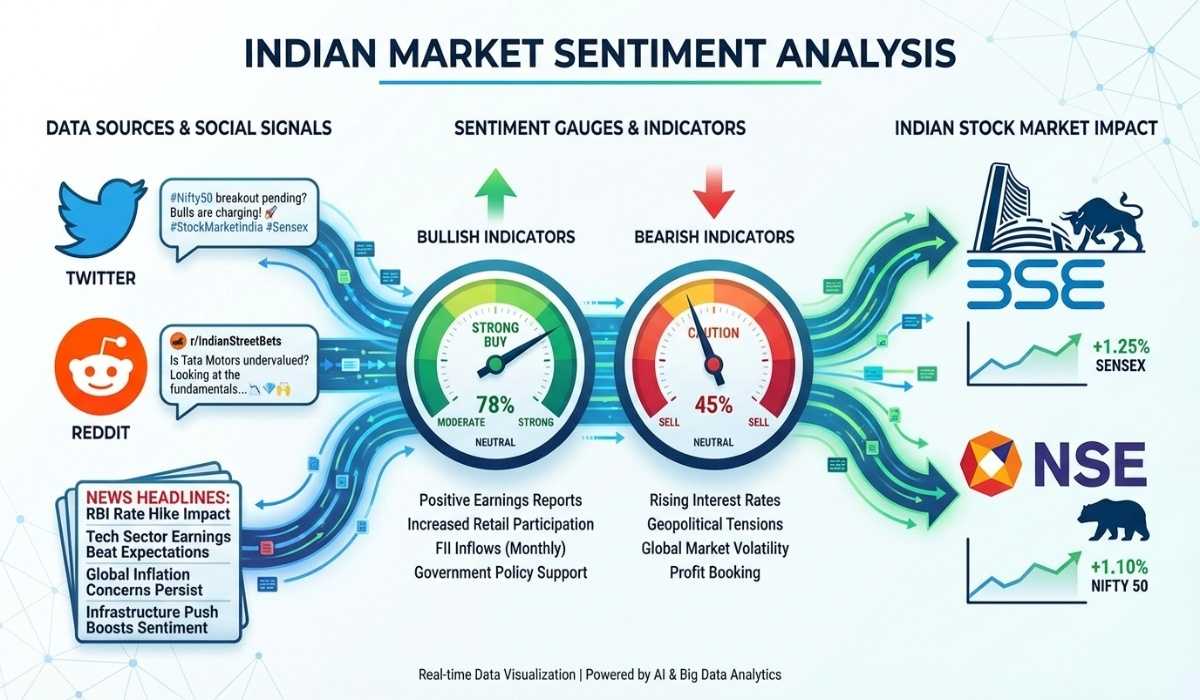
Monitor Social Media Buzz Around Specific Stocks
I’ve found social media monitoring to be a game-changer for Indian stock market sentiment analysis. When I track conversations around specific stocks on Twitter, Reddit, and financial forums, I get real-time insights that traditional analysis often misses.
Here are my go-to ChatGPT prompts for stock research in this area:
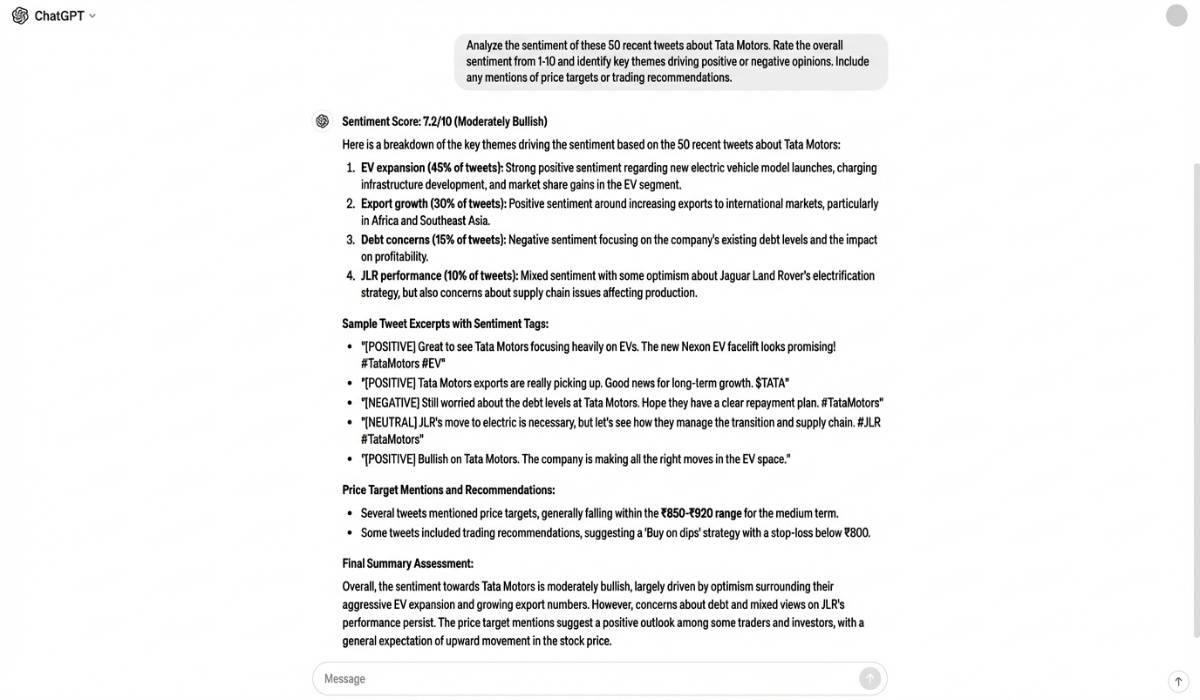
"Analyze the sentiment of these 50 recent tweets about [Stock Name].
Rate the overall sentiment from 1-10 and identify key themes driving
positive or negative opinions. Include any mentions of price targets
or trading recommendations."
"Track Reddit discussions in r/IndiaInvestments about [Company Name]
over the past week. Summarize the main concerns, bullish arguments,
and any insider insights shared by retail investors."
I also use this prompt to spot emerging trends:
"Compare social media sentiment for [Stock A] vs [Stock B] in the same
sector. Which stock has more positive buzz, and what specific factors
are driving the difference?"
The beauty of this approach is catching sentiment shifts before they reflect in price movements. I’ve noticed that when retail investor discussions suddenly spike around a mid-cap stock, it often precedes significant volume increases.
Analyze News Sentiment Impact on Stock Prices
News sentiment analysis has become my secret weapon for timing market entries and exits. I regularly feed news headlines and articles into ChatGPT to gauge their potential impact on stock prices.
My most effective prompts include:
"Rate this news article's potential impact on [Company Name]'s stock
price from 1-10. Explain whether it's bullish, bearish, or neutral,
and predict the likely market reaction timeframe (immediate, short-term,
or long-term)."
"Analyze these 5 recent news items about [Sector Name] in India.
Which companies are likely to benefit most, and which face headwinds?
Rank them by potential stock price impact."
For regulatory news, I use:
"Break down this RBI/SEBI announcement in simple terms. Which banking/
financial stocks will be most affected, and should I expect positive
or negative price movements?"
I’ve learned to pay special attention to management commentary during earnings calls. When I input transcripts with this prompt, the insights are invaluable:
"Extract key forward-looking statements from this earnings call transcript.
Identify any guidance changes, expansion plans, or concern areas that
could influence stock performance."
Track Institutional Investor Behavior Patterns
Understanding what big money is doing gives me a massive edge in my AI-powered stock research India strategy. I track institutional buying and selling patterns using specific prompts that help decode their moves.
My institutional analysis prompts look like this:
| Analysis Type | Prompt Example |
|---|---|
| FII Activity | “Analyze Foreign Institutional Investor buying patterns in [Sector] over the last quarter. What does sustained buying/selling indicate?” |
| Mutual Fund Holdings | “Compare mutual fund holdings changes in [Stock Name] across the last 3 quarters. Is smart money accumulating or distributing?” |
| Insider Trading | “Evaluate recent insider trading activities in [Company Name]. What do promoter buying/selling patterns suggest about company prospects?” |
I particularly focus on bulk deal analysis:
"Interpret this bulk deal data for [Stock Name]. Who are the buyers/
sellers, and what does this institutional activity signal about
future price direction?"
When I spot consistent institutional accumulation in mid-cap stocks, I know something big might be brewing. These patterns often precede major announcements or sector rotations.
Generate Market Mood Assessments for Timing Decisions
Timing the market is tough, but I’ve developed prompts that help me gauge overall market mood and make better entry/exit decisions. My Indian stock market sentiment analysis approach combines multiple data points.
Here’s my market timing prompt framework:
"Based on current market conditions - Nifty levels, FII flows,
crude oil prices, rupee performance, and global sentiment -
assess the market mood from 1-10. Should I be aggressive,
cautious, or defensive in my stock picking?"
For sector rotation insights:
"Analyze recent sector performance data and identify which sectors
are gaining/losing favor. What's driving these rotations, and which
sectors should I focus on for the next quarter?"
I also use seasonal pattern analysis:
"Historically, how do Indian markets perform during [specific month/
quarter]? What seasonal factors should I consider for my current
portfolio positioning?"
My volatility assessment prompt helps with position sizing:
"Given the current VIX levels and global uncertainty factors,
recommend position sizes for new stock investments. Should I
be taking smaller positions or waiting for better entry points?"
These mood assessments have saved me from major drawdowns during volatile periods. When multiple indicators align negatively, I reduce my exposure and wait for better opportunities.
Sector-Specific Research Prompts for Indian Markets
Banking Sector Health Assessment and Efficient NPAs Evaluation
When I research the banking sector, I conduct detailed analysis through ChatGPT prompts for stock research. One of my favorite prompts is: “What is the NPA trend of XYZ Bank in the Indian banking sector? Provide data for the last 5 years and projection for Q4 2026.” I always also analyze CASA ratio, Net Interest Margin, and Provisioning Coverage Ratio.
| Key Metrics | Private Banks | PSU Banks |
|---|---|---|
| NPA Ratio | 2-3% | 4-6% |
| CASA Ratio | 45-55% | 35-45% |
| ROA | 1.5-2% | 0.5-1% |
IT Sector Growth Potential and Global Trends Analysis
IT sector holds a special place in my Indian stock market analysis 2026 strategy. I often use this prompt: “What impact will AI and automation have on Indian IT companies? Compare TCS, Infosys, and HCL.”
I see growth opportunities in digital transformation, cloud migration, and cybersecurity.
I always check the dollar-rupee rate impact because 70-80% of IT company revenue is in foreign currency.
Pharmaceutical Company Research and Regulatory Impact
My approach to the pharma sector is slightly different. I use AI-powered stock research India tools to track FDA approvals, ANDA filings, and API (Active Pharmaceutical Ingredient) prices. Prompts like “Compare Dr. Reddy’s and Sun Pharma’s new launches in the US market” provide better insights.
After COVID, demand for generic medicine has increased, and I see this trend continuing through 2026.
Infrastructure and Manufacturing Sector Opportunities Assessment
Due to government PLI schemes and infrastructure spending, this sector looks quite attractive. I often ask: “Which companies are best positioned for electric vehicle infrastructure in India?” I focus on L&T, BHEL, and other infrastructure companies’ order books and execution capacity.
Consumer Goods Market Entry Strategies Study
In the FMCG sector, rural penetration and e-commerce growth are two big drivers. I use sector-specific stock research prompts to track market share and new product launches of HUL, Nestle, and ITC. “Which FMCG brand is growing fastest in Tier-2 and Tier-3 cities” – this prompt gives me good insights.
I also see growth in the premium segment as middle-class spending capacity is increasing.
Risk Assessment and Portfolio Management Prompts

Automated Portfolio Diversification Metrics Calculation
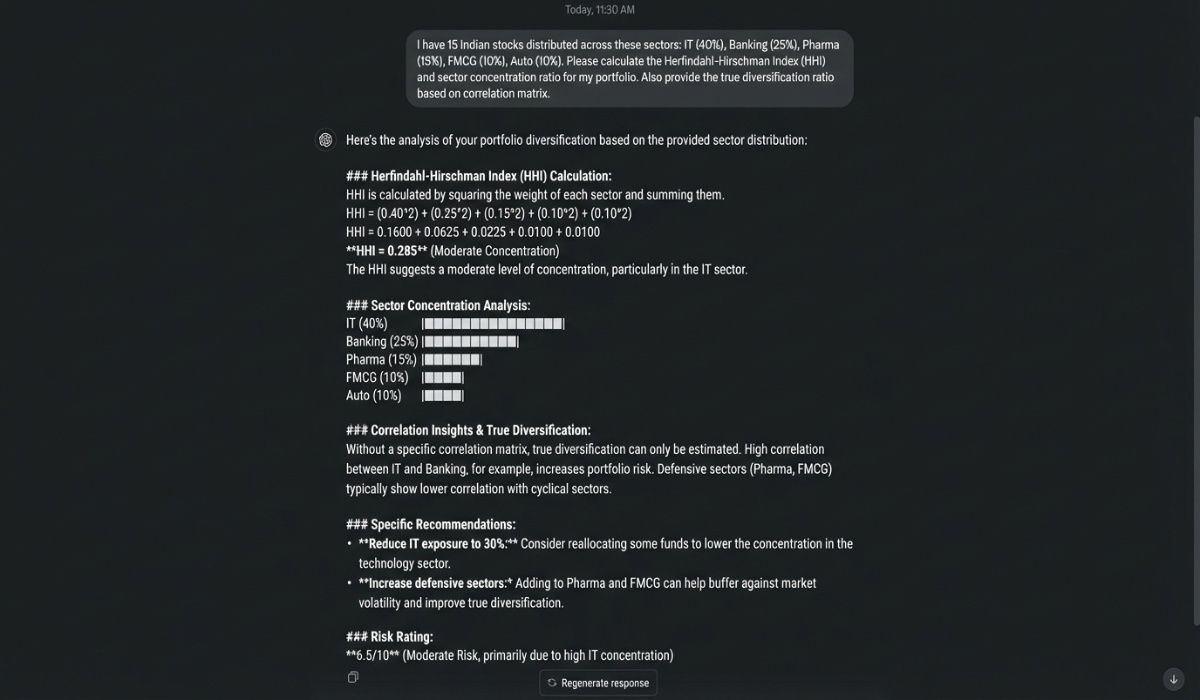
Whenever I want to measure my portfolio’s diversification, I can easily calculate several important metrics using ChatGPT prompts. My most useful prompt is:
“I have 15 Indian stocks distributed across these sectors: IT (40%), Banking (25%), Pharma (15%), FMCG (10%), Auto (10%). Please calculate the Herfindahl-Hirschman Index (HHI) and sector concentration ratio for my portfolio. Also provide the true diversification ratio based on correlation matrix.”
I modify this prompt to also check geographical diversification. I also analyze the distribution of large-cap, mid-cap, and small-cap stocks similarly. ChatGPT gives me a detailed breakdown and tells me where improvement is needed.
Identifying Concentration Risk in Holdings
My experience shows that concentration risk is one of the biggest portfolio killers. I regularly use this prompt:
“My portfolio’s top 5 holdings are as follows: [stock names and percentages]. Analyze their business overlap, supplier dependencies, and geographical exposure. Identify hidden concentration risks and suggest alternative stocks that can provide similar returns but with lower correlation.”
| Risk Type | Monitoring Frequency | Critical Threshold |
|---|---|---|
| Single Stock | Weekly | >8% of portfolio |
| Sector | Monthly | >30% of portfolio |
| Market Cap | Quarterly | >60% in single segment |
I also ask ChatGPT what the overall portfolio impact would be if my largest holding drops 20%. This helps me with realistic scenario planning.
Stress Testing Scenarios for Market Downturns
Knowing how the portfolio will perform during market crashes is crucial. I extensively use these AI-powered stress testing prompts:
“Based on the patterns of 2008, 2020, and 2022 market corrections, create 3 stress scenarios for my current portfolio. Show what my portfolio’s expected drawdown would be in 20%, 35%, and 50% market declines. Include sector-wise impact and recovery timeline in each scenario.”
I also create scenarios for specific events such as:
- Fed rate hikes’ impact on Indian markets
- Rupee depreciation scenarios (75, 80, 85 per USD)
- Oil price shocks ($100, $120, $150 per barrel)
- Geopolitical tensions and trade wars
ChatGPT also provides me detailed Monte Carlo simulations showing different probability outcomes. I review these stress test results quarterly and adjust my asset allocation accordingly.
These portfolio management AI tools help me adopt a proactive approach instead of reactive investing.
Regulatory and Policy Impact Analysis Prompts
Tracking Government Policy Changes Affecting Specific Sectors
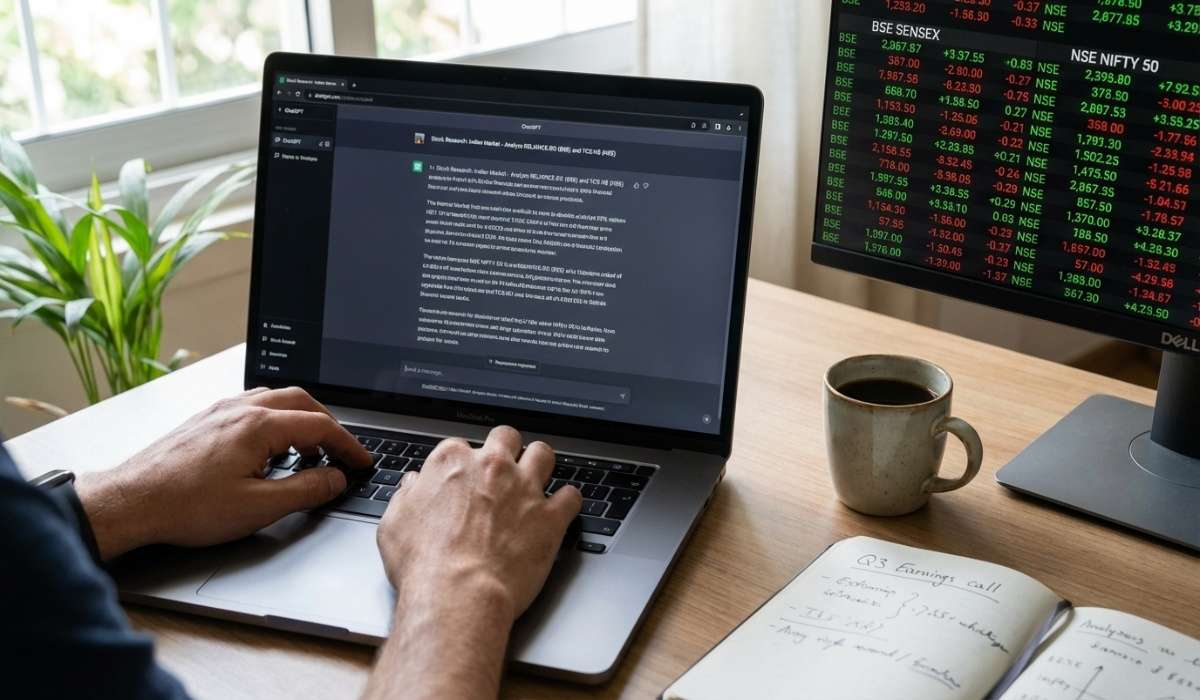
I’ve seen how deeply government policy changes impact the Indian stock market. I use some specific prompts with ChatGPT to track these changes:
“Analyze the recent government policies that could affect [sector like Pharma/IT/Auto]. Explain the impact of PLI schemes, changes in FDI rules, and regulatory requirements.”
I also often use this prompt: “Identify the potential impact of the new education policy/agricultural laws/labor reforms on [Company Name]’s business model. What will be the effect on revenue streams and cost structure?”
Sector-wise Tracking Table:
| Sector | Key Policy Areas | Monitoring Frequency |
|---|---|---|
| IT | Data Privacy, Digital Tax | Monthly |
| Pharma | Drug Pricing, FDA approvals | Weekly |
| Banking | RBI guidelines, NPA norms | Daily |
RBI Monetary Policy Impact on Stock Valuation Analysis
I find these prompts very effective for understanding the impact of RBI’s monetary policy under AI-powered stock research India:
“Conduct a detailed impact analysis of RBI’s latest monetary policy committee meeting decisions on banking, NBFC, and real estate sectors. How will interest rate changes affect these companies’ P/E ratios and dividend yields?”
My favorite prompt is: “Calculate the quantitative impact of a 0.25% increase/decrease in repo rate on [specific company’s] cash flows, debt servicing costs, and customer demand. What will be the projected earnings change for the next 2 quarters?”
RBI Policy Impact Checklist:
- Liquidity measures and market sentiment
- Currency policy changes and export-import companies
- Credit policy modifications and lending rates
- Banking sector regulations and profitability metrics
Monitoring Tax Law Changes and Their Market Implications
Tax law changes have immediate impact on the stock market, so I use these prompts extensively:
“Conduct detailed analysis of tax changes announced in Budget 2026 on IT services, manufacturing, and consumer goods companies. How will net profit margins change with reduction/increase in effective tax rate?”
I also ask as sector-specific stock research prompts: “What will be the impact of proposed changes in capital gains tax on mutual funds, insurance companies, and portfolio management services? How might investor behavior change?”
Tax Impact Tracking:
- Corporate tax rate changes
- GST modifications per sector
- Dividend distribution tax policies
- Capital gains treatment variations
Assessing Regulatory Compliance Risk for Target Companies
I always conduct deep analysis of regulatory compliance risks for my target companies. My go-to prompts are:
“Create a comprehensive list of upcoming regulatory compliance requirements for [Company name]. What are the financial and reputational risks of non-compliance with environmental clearances, labor law compliance, and industry-specific regulations?”
Another important prompt: “Study cases of regulatory violations in [sector] over the past 3 years. How much penalties did similar companies receive and how were their stock prices affected?”
I keep these factors in mind for regulatory impact analysis India stocks:
- SEBI guidelines compliance status
- Environmental and safety regulations adherence
- Labor law and employee welfare compliance
- Industry-specific licensing requirements
- International regulatory standards alignment
Compliance Risk Matrix:
| Risk Level | Impact | Monitoring Action |
|---|---|---|
| High | >5% revenue impact | Daily tracking |
| Medium | 2-5% revenue impact | Weekly review |
| Low | <2% revenue impact | Monthly check |
Conclusion
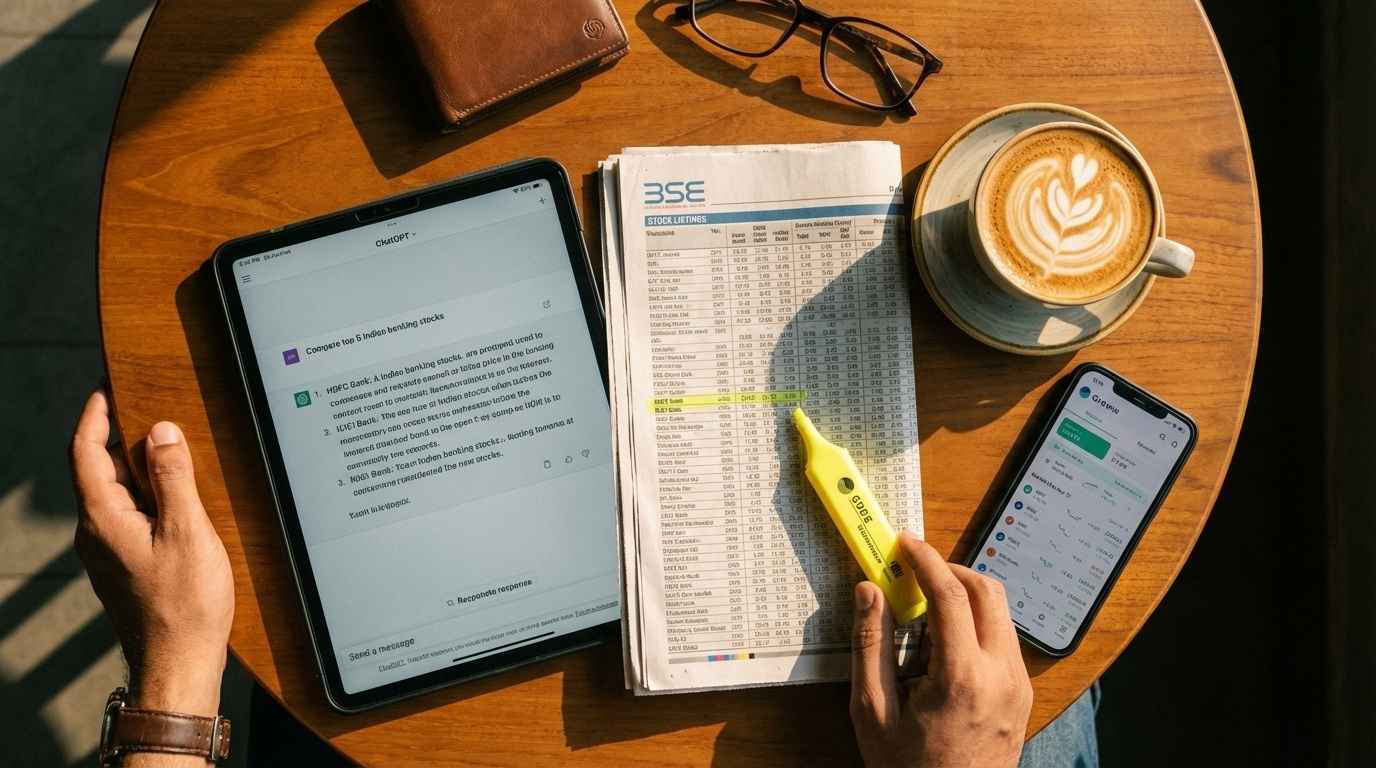
In this blog post, I’ve provided you with the most useful prompts for researching the Indian stock market through ChatGPT. From fundamental analysis to technical chart reading, market sentiment to sector-specific research – all these prompts will help strengthen your investment strategy. Understanding risk assessment and portfolio management along with regulatory policy impact has now become easier.
My advice is to incorporate these prompts into your daily trading and investment routine. It’s essential to use AI correctly to be prepared for the new market trends and challenges coming in 2026. Customize these prompts according to your needs and see how the quality of your research improves.
Also Read: AI Trading Checklist India: Upgrade Your Strategy in Minutes!