
I’ve been using AI tools for investment research for over two years now, and I can tell you that Gemini prompts for mutual fund research have completely changed how I analyze Indian funds. If you’re a retail investor, financial advisor, or fund analyst looking to make smarter investment decisions, this guide will show you exactly how to use Gemini AI investment queries to research Indian mutual funds like a pro.
The Indian mutual fund industry is getting more complex every year, with over 40 AMCs and thousands of schemes to choose from. I used to spend hours manually comparing fund performance, reading annual reports, and trying to understand manager strategies. Now, I use targeted AI-powered fund research tools to cut through the noise and find the data that actually matters.
In this post, I’ll walk you through my favorite mutual fund performance evaluation prompts that help me screen funds faster than ever before. I’ll share the exact queries I use for Indian AMC research using AI, including how to analyze fund manager track records and spot red flags in portfolio construction. You’ll also learn my go-to prompts for regulatory compliance mutual fund research, which saves me from missing important tax implications and regulatory changes that could impact returns.
By the end, you’ll have a toolkit of proven Gemini queries that will make your 2026 investment research more efficient and thorough.
Understanding Gemini AI’s Capabilities for Indian Mutual Fund Analysis
Core features that enhance investment research accuracy
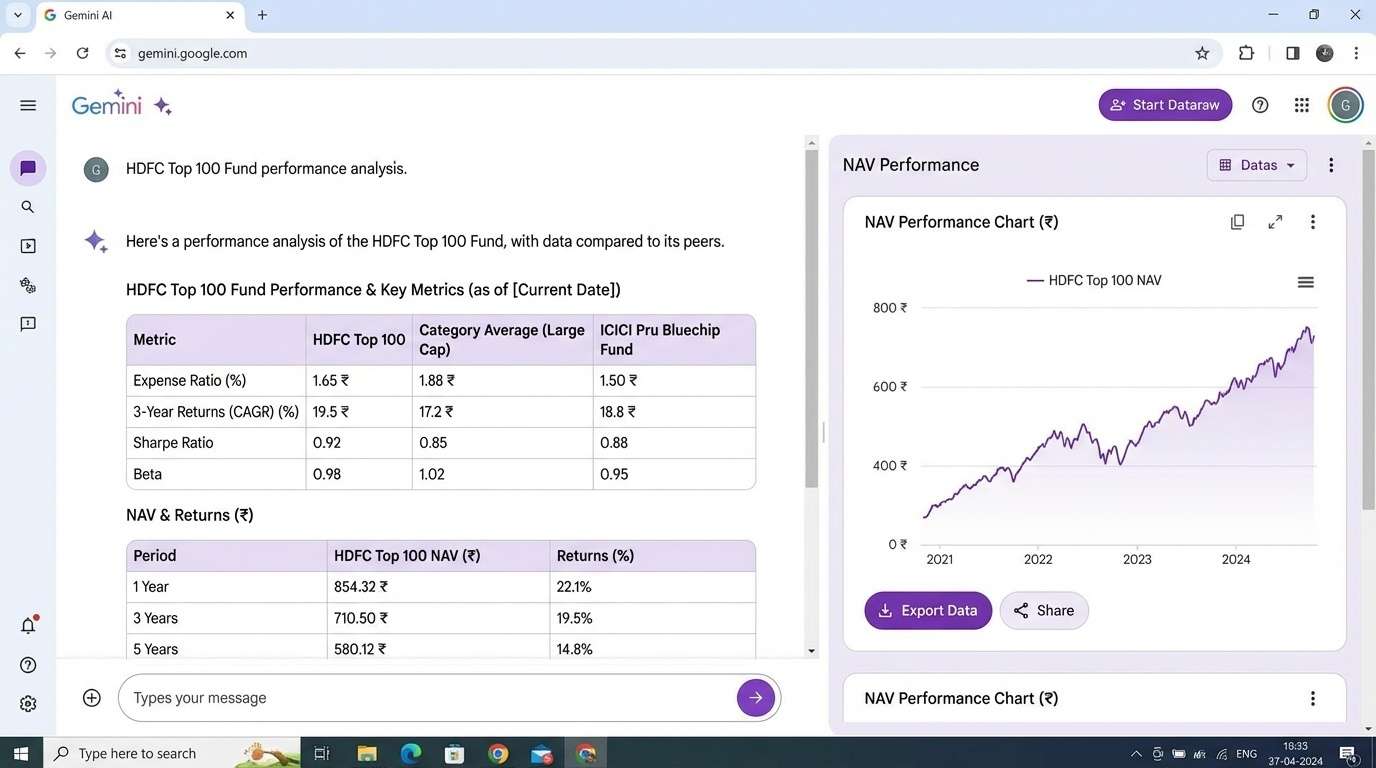
When I analyze Indian mutual funds using Gemini AI, I’m amazed by how its multimodal capabilities transform my research process. The AI can simultaneously process text documents, financial charts, and numerical data from annual reports, making my analysis much more comprehensive than traditional methods.
What really sets Gemini apart for mutual fund research is its ability to understand context across different data sources. I can feed it a fund’s fact sheet alongside market commentary and economic reports, and it connects the dots between seemingly unrelated information. This contextual understanding helps me spot patterns that might take hours to identify manually.
The AI’s reasoning capabilities shine when I’m evaluating fund performance metrics. Instead of just crunching numbers, Gemini explains the “why” behind performance variations. It can analyze expense ratios, portfolio turnover, and benchmark comparisons while considering market conditions and fund strategy changes.
I particularly value how Gemini handles complex financial calculations and ratios. When I input raw data about NAV movements, AUM changes, or sector allocations, it not only computes standard metrics like Sharpe ratio and alpha but also provides insights about what these numbers mean in the current market context.
The AI’s ability to process multiple document formats simultaneously means I can upload PDF annual reports, Excel spreadsheets with historical data, and text-based research notes all at once, creating a unified analysis framework.
Natural language processing advantages for financial data interpretation
My experience with Gemini’s natural language processing for Indian mutual fund analysis has been game-changing. The AI understands financial jargon specific to Indian markets, from technical terms like “dividend distribution tax” to regulatory concepts like SEBI guidelines and AMC compliance requirements.
When I ask questions in plain English about complex fund strategies, Gemini translates technical fund manager commentary into actionable insights. For example, if a fund manager mentions “tactical asset allocation based on macro-economic indicators,” the AI breaks down what this means for actual investment performance and risk levels.
The conversational approach makes my research more efficient. Instead of spending time decoding financial statements, I can ask direct questions like “What’s driving the high expense ratio in this mid-cap fund?” and get detailed explanations that consider industry benchmarks and regulatory frameworks.
Gemini’s language processing excels at sentiment analysis of fund manager interviews and market commentary. It can identify subtle shifts in investment philosophy or risk appetite from quarterly updates, helping me gauge potential strategy changes before they impact performance.
The AI also handles regional language nuances in Indian financial documents. When analyzing reports that contain Hindi terms or India-specific financial concepts, Gemini maintains accuracy while providing clear English explanations.
Integration capabilities with Indian financial platforms
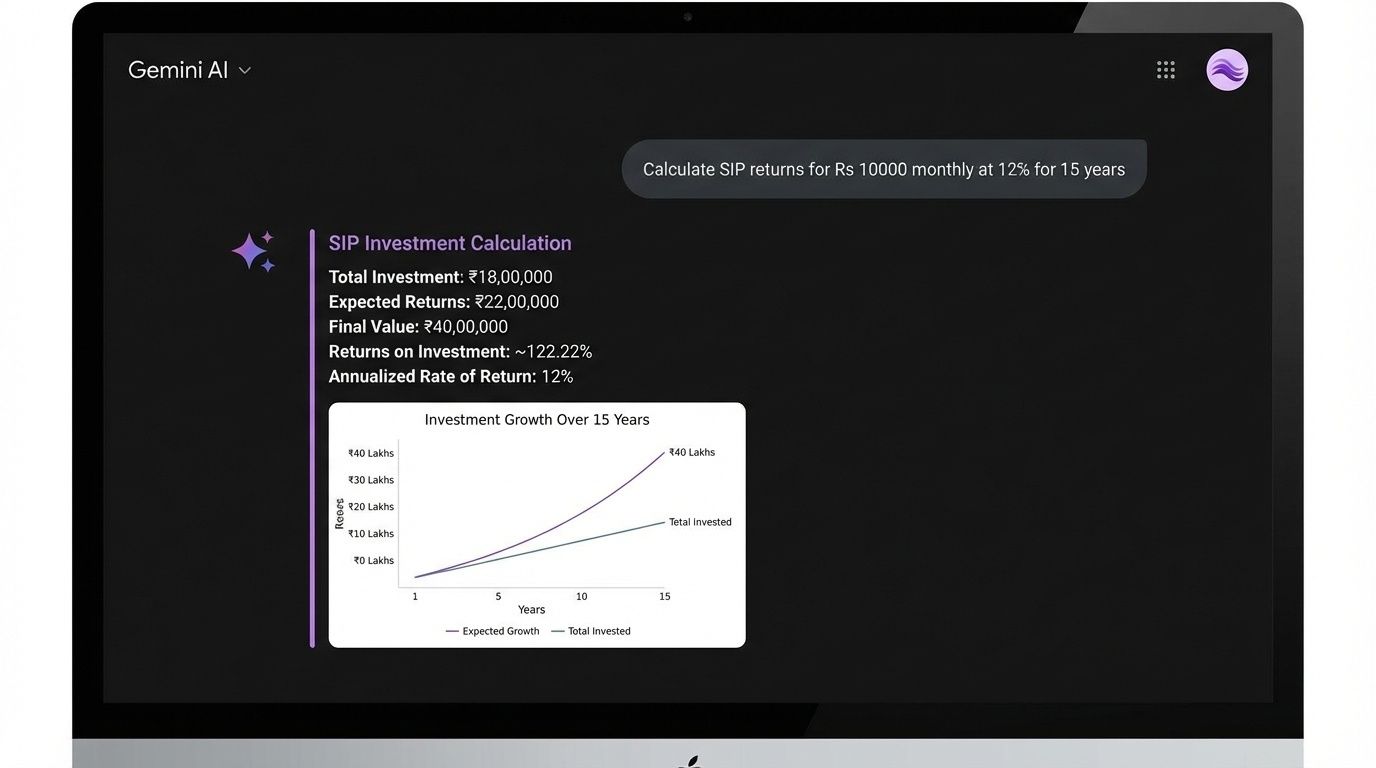
I’ve found Gemini’s integration potential with Indian financial platforms particularly promising for streamlining my mutual fund research workflow. While direct API integrations are still developing, the AI’s ability to process data from various Indian financial sources creates powerful research possibilities.
The AI can analyze data formats commonly used by Indian platforms like Value Research, Morningstar India, and AMFI websites. When I copy-paste fund data from these sources, Gemini maintains formatting context and can cross-reference information across multiple platforms for comprehensive analysis.
For regulatory compliance research, Gemini processes SEBI circulars and AMC disclosures effectively. I can input regulatory updates alongside fund portfolios to understand compliance implications and potential strategy adjustments.
The AI’s capability to handle Indian financial data standards, including INR formatting and Indian market timings, ensures accuracy in my calculations and comparisons. It recognizes Indian financial year structures and can adjust analyses accordingly.
When working with tax-related mutual fund research, Gemini understands Indian tax regulations including LTCG, STCG, and dividend taxation rules, making it valuable for holistic investment planning beyond just fund selection.
Real-time data processing for market trend analysis
My approach to market trend analysis has evolved significantly with Gemini’s real-time data processing capabilities. The AI can quickly process current market information and relate it to historical mutual fund performance patterns, giving me timely insights for investment decisions.
When I input recent market data alongside fund portfolios, Gemini identifies correlation patterns and potential impact scenarios. For instance, during volatile market periods, it can analyze how similar funds performed during comparable situations and project likely outcomes.
The AI excels at processing multiple market indicators simultaneously. I can input data about interest rate changes, inflation trends, sectoral performance, and global market movements, and Gemini weaves these factors into a coherent analysis of how they might affect specific mutual fund categories.
For sector rotation strategies, Gemini’s real-time processing helps me identify emerging trends before they become obvious. By analyzing current economic data alongside fund sector allocations, it suggests timing considerations for different fund categories.
The speed of analysis is particularly valuable during market events. When major announcements or economic data releases occur, I can quickly input the information and get immediate analysis of potential impacts on my tracked mutual funds, enabling faster decision-making in dynamic market conditions.
Essential Prompts for Fund Performance Evaluation
Historical return analysis across different market cycles
When I analyze Indian mutual funds using Gemini AI, I focus on crafting prompts that reveal how funds performed across various market conditions. My go-to prompt starts with: “Compare the performance of [Fund Name] during the 2008 financial crisis, 2020 pandemic crash, and the 2015-2016 market correction. Show rolling returns for 1, 3, and 5-year periods starting from each crisis point.”
I’ve found that asking Gemini to break down returns by market phases gives me deeper insights. My preferred approach is: “Analyze [Fund Name]’s performance during bull markets (2014-2017, 2020-2021) versus bear markets (2018, 2022). Calculate the capture ratios and highlight periods where the fund outperformed or underperformed its benchmark significantly.”
For sector-specific funds, I use this prompt: “Evaluate how [Sectoral Fund Name] performed relative to broader market indices during sectoral rotation phases in Indian markets from 2019-2024. Identify the fund’s resilience during unfavorable sectoral cycles.”
Risk-adjusted return calculations and comparisons
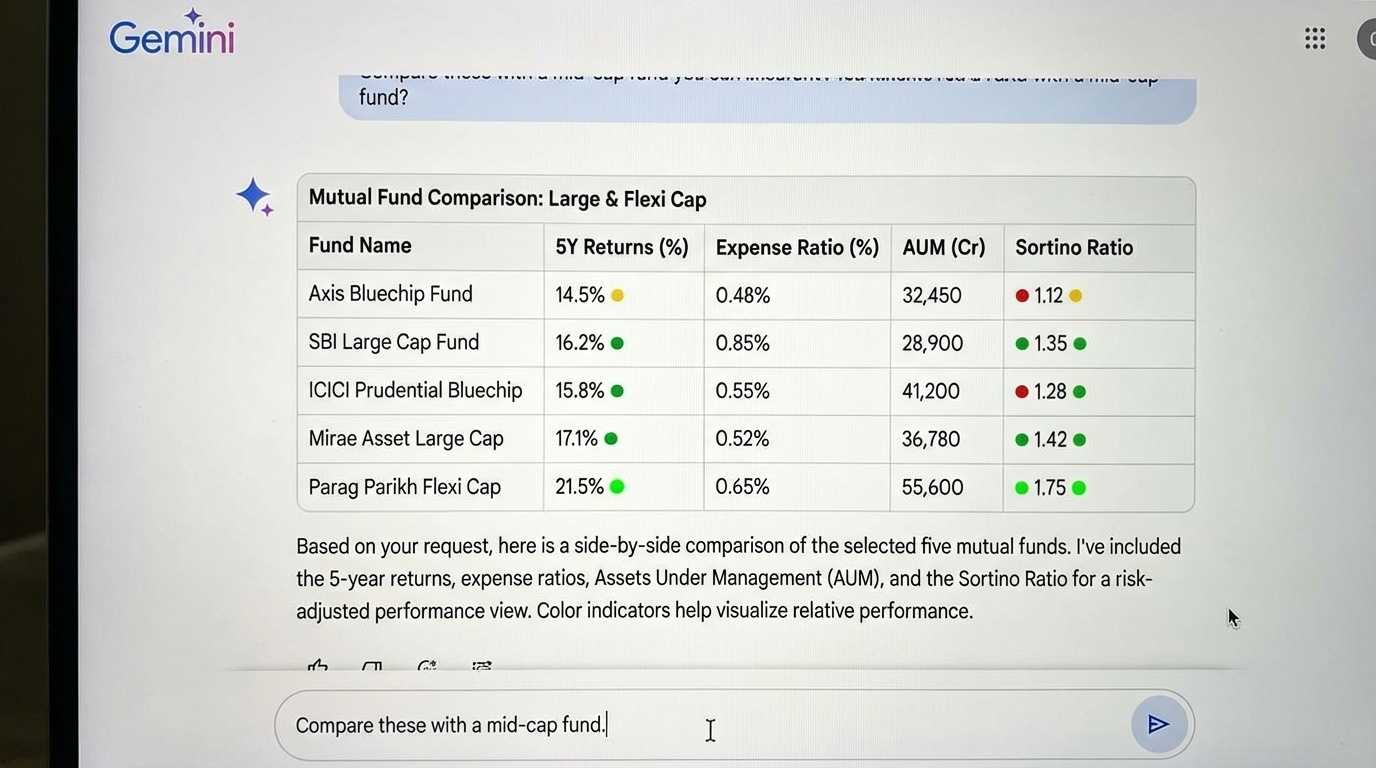
My experience with Gemini prompts for mutual fund research has taught me that raw returns tell only half the story. I always start with Sharpe ratio analysis using this prompt: “Calculate and compare the Sharpe ratios of [Fund A], [Fund B], and [Fund C] over 3, 5, and 10-year periods. Include the risk-free rate based on 10-year government securities for each period.”
I dig deeper with Sortino ratios by prompting: “Compute Sortino ratios for [Fund Name] focusing only on downside volatility. Compare this with the category average and explain which fund offers better downside protection for Indian investors.”
For comprehensive risk assessment, I use: “Generate a risk-return matrix comparing [List of Funds] using standard deviation, beta, alpha, and information ratio. Highlight funds that consistently deliver superior risk-adjusted returns across different time horizons.”
Expense ratio impact assessment on long-term returns
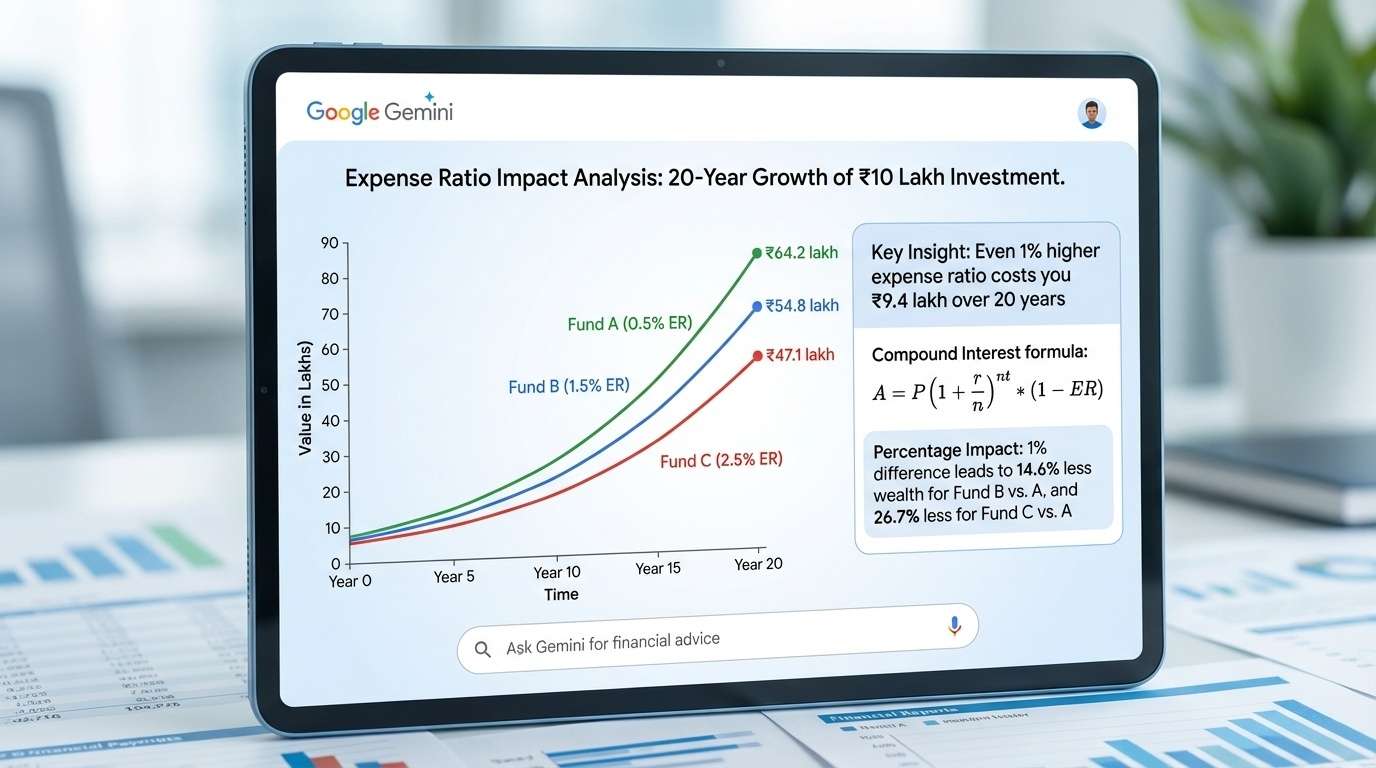
I’ve learned that expense ratios can significantly erode wealth over time, so I prompt Gemini with: “Calculate the impact of expense ratios on a ₹1 lakh SIP over 15 years for funds with expense ratios of 0.5%, 1.2%, and 2.1%. Assume an annual return of 12% before expenses and show the wealth differential.”
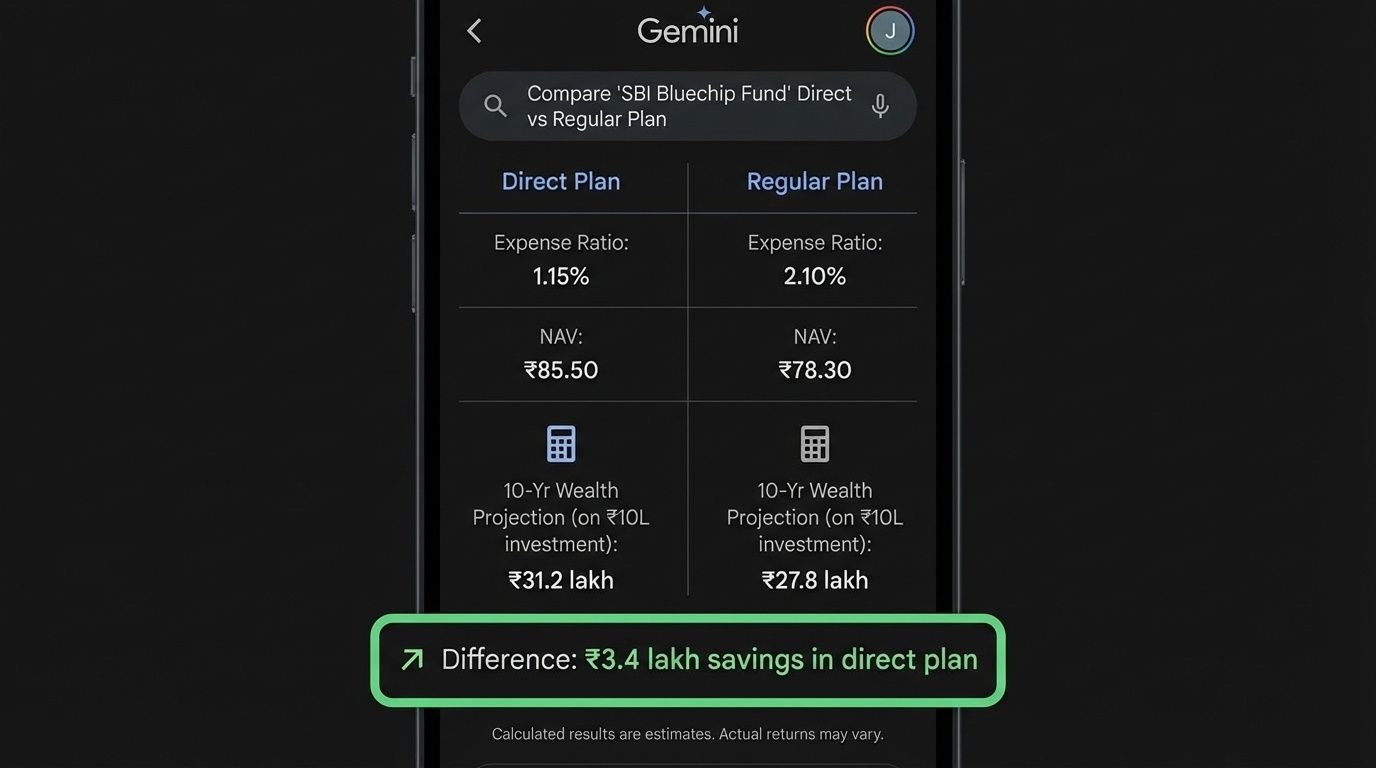
My detailed analysis prompt reads: “Compare direct and regular plan expense ratios for [AMC Name]’s equity funds. Calculate the break-even period where direct plan advantages become significant for lump-sum investments of ₹5 lakhs and ₹20 lakhs.”
For category-wise analysis, I ask: “Analyze expense ratio trends across large-cap, mid-cap, and small-cap fund categories from 2020-2024. Identify funds offering the best value proposition in each category based on performance per unit of expense.”
I also use this prompt for deeper insights: “Examine the correlation between expense ratios and fund performance in the Indian mutual fund industry. Identify instances where higher expenses are justified by superior alpha generation and fund management expertise.”
Market Trend Analysis Through Strategic Gemini Queries
Sectoral Allocation Trends in Indian Equity Funds
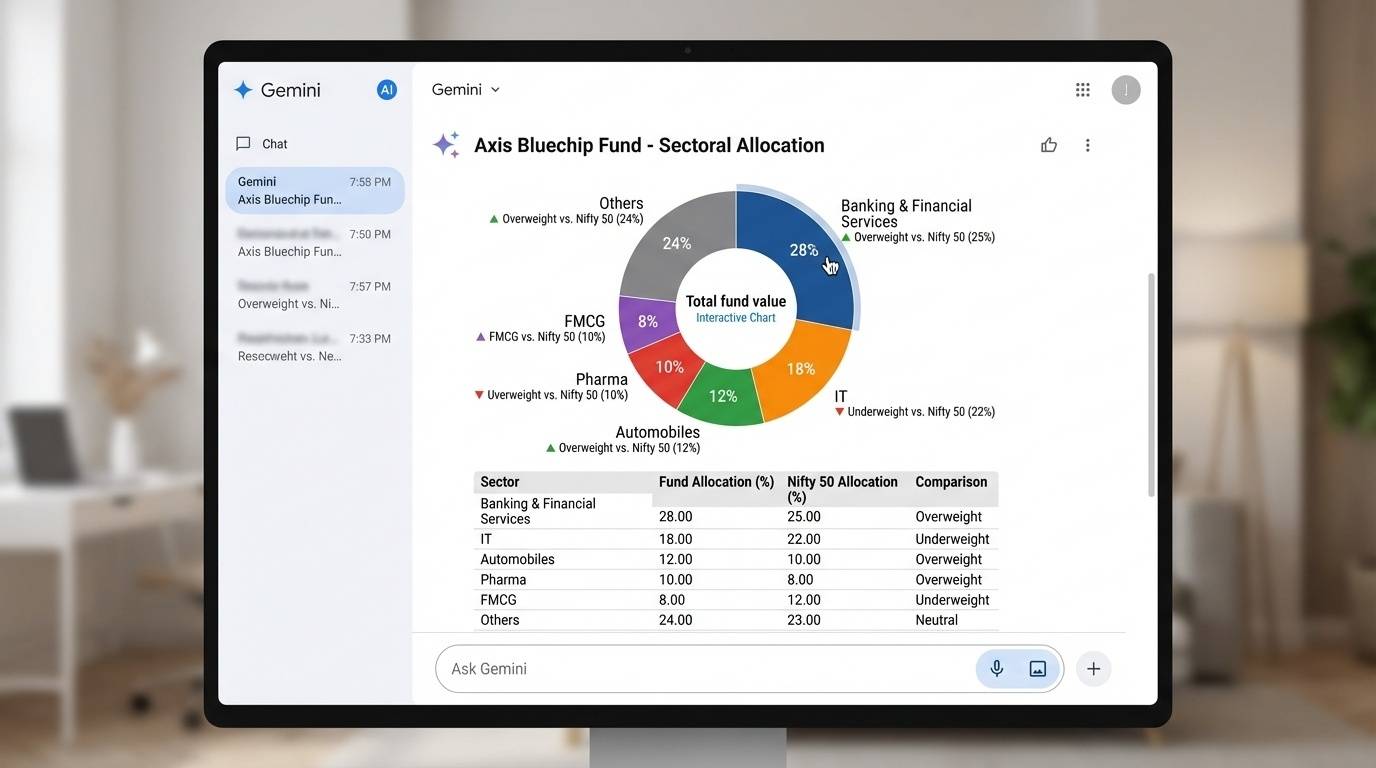
When I analyze sectoral allocation trends using Gemini AI, I focus on crafting prompts that reveal the shifting landscape of Indian equity funds. My go-to approach starts with sector-specific queries that dig deep into allocation patterns across different time periods.
I ask Gemini to “Compare the top 5 sectoral allocations in large-cap Indian equity funds from Q1 2024 to Q3 2024, highlighting percentage changes and identifying which sectors are gaining or losing favor among fund managers.” This gives me a clear picture of where the smart money is moving.
For banking and financial services, which traditionally dominate Indian portfolios, I use targeted prompts like “Analyze the weight reduction in banking stocks across top 10 Indian equity funds and explain the underlying reasons for this shift.” The AI helps me understand whether managers are rotating due to valuation concerns or regulatory headwinds.
Technology and pharmaceuticals deserve special attention in my research. I prompt Gemini with “Identify Indian equity funds that have increased their pharma allocation by more than 2% in the last six months and analyze their performance attribution to this sector bet.” This reveals which fund managers are positioning for sector-specific opportunities.
My analysis always includes emerging sectors. I ask “Which Indian mutual funds have the highest allocation to renewable energy, electric vehicles, and digital infrastructure themes, and how do their allocations compare to benchmark indices?” This helps me spot funds that are ahead of the curve.
Emerging Investment Themes for 2026 Outlook
My research into emerging investment themes requires forward-looking Gemini prompts that capture the evolution of Indian markets. I structure my queries to identify themes that will likely dominate the 2026 investment landscape.
Digital transformation remains a key focus area. I ask Gemini to “List Indian mutual funds with significant exposure to fintech, edtech, and healthtech companies, and analyze their performance correlation with digital adoption metrics.” This helps me understand which funds are best positioned for India’s digital revolution.
Infrastructure development presents massive opportunities. My prompt typically reads “Identify funds with high allocation to infrastructure, logistics, and urban development themes, and compare their holdings with government infrastructure spending priorities for 2025-2026.” The AI provides insights into funds aligned with policy tailwinds.
ESG (Environmental, Social, Governance) investing is gaining traction. I use “Analyze the ESG score trends of top Indian equity funds and identify which funds have launched dedicated ESG products in the last 12 months.” This reveals how fund houses are adapting to sustainable investing demands.
Consumer behavior shifts create new opportunities. I prompt “Examine funds with exposure to direct-to-consumer brands, quick commerce, and premium consumption themes, analyzing their correlation with changing Indian consumer patterns.” This uncovers funds riding demographic and lifestyle changes.
Healthcare innovation deserves attention. My query focuses on “Identify mutual funds investing in Indian biotech, telemedicine, and medical device companies, and analyze their performance against traditional pharma-heavy funds.”
Macroeconomic Factor Impact on Fund Categories
Understanding how macroeconomic factors influence different fund categories requires sophisticated AI-powered analysis. I design my Gemini prompts to capture these complex relationships across various market conditions.
Interest rate sensitivity analysis forms the core of my research. I ask “Analyze the correlation between RBI repo rate changes and performance of debt funds across different duration categories, providing specific examples from the last two rate cycles.” This reveals which fund categories perform best in different rate environments.
Inflation impact assessment requires detailed questioning. My typical prompt reads “Compare the performance of different equity fund categories during high inflation periods (above 6%) versus low inflation periods, focusing on sector allocation changes and alpha generation.” The AI helps me understand inflation hedging capabilities across fund types.
Currency movements significantly impact certain categories. I use “Examine how rupee depreciation affects international funds, gold funds, and export-oriented equity funds, providing correlation coefficients and specific performance data.” This analysis guides allocation decisions during currency volatility.
For commodity exposure, I prompt “Identify Indian mutual funds with indirect and direct commodity exposure and analyze their performance during different commodity cycles, particularly during agricultural and energy price fluctuations.” This reveals natural hedges within traditional equity portfolios.
GDP growth correlation matters for sector funds. I ask “Analyze the relationship between India’s GDP growth rates and performance of infrastructure, banking, and consumption-focused sector funds over the last five years.” This helps predict which categories might outperform in different growth scenarios.
Comparative Analysis with Global Market Trends
My global comparative analysis using Gemini AI helps position Indian mutual fund investments within the broader international context. I craft prompts that reveal how Indian funds stack up against global peers and trends.
Performance benchmarking starts with broad market comparisons. I ask “Compare the 3-year rolling returns of top Indian large-cap funds with equivalent US large-cap funds, European equity funds, and emerging market funds, adjusting for currency effects.” This provides perspective on relative performance across regions.
Valuation metrics deserve global context. My prompt typically reads “Analyze the P/E and P/B ratios of Indian equity fund portfolios compared to similar funds in other emerging markets and developed markets, highlighting where Indian valuations stand globally.” The AI reveals whether Indian funds offer relative value.
Sector allocation differences provide insights into market maturity. I use “Compare the sector allocation patterns of Indian equity funds with global equity funds, identifying unique overweights and underweights in the Indian market.” This analysis shows where Indian market structure differs from global norms.
Risk-adjusted returns need international perspective. I prompt “Calculate and compare the Sharpe ratios and maximum drawdowns of Indian equity funds versus global emerging market funds and developed market funds over multiple time periods.” This reveals whether Indian funds compensate investors adequately for higher volatility.
For thematic exposure, I ask “Identify global investment themes (like AI, clean energy, aging population) and analyze how Indian mutual funds compare to international funds in capturing these opportunities.” This helps me understand where Indian funds might be missing global trends or finding unique local opportunities.
ESG integration comparison rounds out my analysis. I use “Compare the ESG scores and sustainable investing approaches of leading Indian AMCs with global asset managers, identifying gaps and leading practices in responsible investing.”
Fund Manager and AMC Research Optimization
Track Record Evaluation of Fund Management Teams
When I’m researching Indian mutual funds using Gemini AI, I find that evaluating fund managers requires more than just looking at returns. My approach involves crafting specific Gemini prompts for mutual fund research that dig deep into the management team’s consistency and decision-making patterns.
I start by asking Gemini to analyze a fund manager’s performance across different market cycles. My typical prompt goes like this: “Analyze [Fund Manager Name]’s portfolio decisions during the 2008 crash, 2020 pandemic, and current market conditions. Compare their sector allocation changes and stock-picking accuracy across these periods.”
For team-managed funds, I prompt Gemini to break down individual contributions: “Evaluate the track record of each team member in [Fund Name], including their previous roles, portfolio management experience, and specific stocks they’ve championed.” This helps me understand whether success comes from one star performer or collective expertise.
I also use Gemini to examine consistency metrics beyond standard deviation. My prompts focus on rolling returns analysis: “Calculate 3-year rolling returns for [Fund] over the past decade and identify periods of significant outperformance or underperformance. What market conditions or fund manager decisions contributed to these variations?”
Asset Management Company Stability Assessment
My Indian AMC research using AI has taught me that institutional stability directly impacts fund performance. I’ve developed specific prompts to evaluate AMC health beyond just AUM figures.
I start with financial stability prompts: “Analyze [AMC Name]’s revenue diversification, expense ratios trends, and profitability metrics over the past 5 years. How does their business model compare to top-tier AMCs like HDFC or ICICI Prudential?” This gives me insight into whether the AMC can weather market downturns.
For ownership structure analysis, I prompt: “Examine the shareholding pattern of [AMC], including promoter stability, institutional backing, and any recent ownership changes. How might these factors influence fund management decisions and investor confidence?”
I pay special attention to compliance and regulatory standing. My go-to prompt is: “Review [AMC]’s regulatory history with SEBI, including any penalties, warnings, or compliance issues in the past 3 years. Compare this record with industry peers and assess potential risks to fund operations.”
Distribution network strength matters too. I ask Gemini: “Evaluate [AMC]’s distribution channels, digital adoption, and investor service capabilities. How do their AUM growth patterns compare to marketing spend and distribution investments?”
Investment Philosophy Alignment Verification
Matching my investment goals with a fund’s actual philosophy requires careful analysis. I’ve learned to use AI-powered fund research tools to look beyond marketing materials and examine real portfolio actions.
My primary verification prompt focuses on stated versus actual strategy: “Compare [Fund Name]’s investment philosophy document with their actual portfolio holdings over the past 3 years. Identify any deviations in market cap allocation, sector concentration, or stock selection criteria.”
I dig deeper into consistency with sector-specific queries: “Analyze [Fund Manager]’s technology sector picks over the past 5 years. Do their selections align with their stated growth vs value philosophy? How have their tech investments performed relative to the sector index?”
For style drift detection, I prompt: “Track [Fund]’s portfolio characteristics monthly for the past 2 years. Chart changes in average market cap, P/E ratios, and sector allocations. Flag periods where the fund deviated significantly from its stated investment style.”
I also verify ESG alignment where claimed: “Examine [ESG Fund]’s holdings for companies with ESG controversies or poor sustainability ratings. How does their screening process match their stated ESG criteria?”
Succession Planning Impact on Fund Continuity
Fund manager changes can significantly impact performance, so I use targeted prompts to assess succession planning and its implications for fund continuity.
I start with historical transition analysis: “Research all fund manager changes at [AMC] over the past decade. Analyze performance patterns 12 months before and after each transition. Identify funds that maintained consistency versus those that experienced significant strategy shifts.”
For current succession planning assessment, I prompt: “Evaluate the management depth at [AMC] for their flagship funds. Identify deputy fund managers, analysts who’ve been groomed for leadership roles, and the average tenure of the management team.”
My risk assessment prompts focus on key person dependency: “Analyze [Star Fund Manager]’s role in fund decisions. Are there established processes, investment committees, or co-managers who could maintain continuity? What happened to similar funds when star managers left other AMCs?”
I also examine communication during transitions: “Review [AMC]’s disclosure practices during past fund manager changes. How transparently do they communicate transition plans, and what assurances do they provide to investors about strategy continuity?”
| Succession Planning Factor | Assessment Criteria | Impact Level |
|---|---|---|
| Management Depth | Number of qualified deputies | High |
| Process Documentation | Systematic investment approach | Medium |
| Transition Communication | Investor disclosure quality | Medium |
| Historical Track Record | Past succession success rate | High |
These fund manager analysis Gemini prompts help me make informed decisions about fund stability and long-term investment potential in the evolving 2026 landscape.
Risk Assessment and Portfolio Construction Prompts![]()
Volatility pattern identification across fund categories
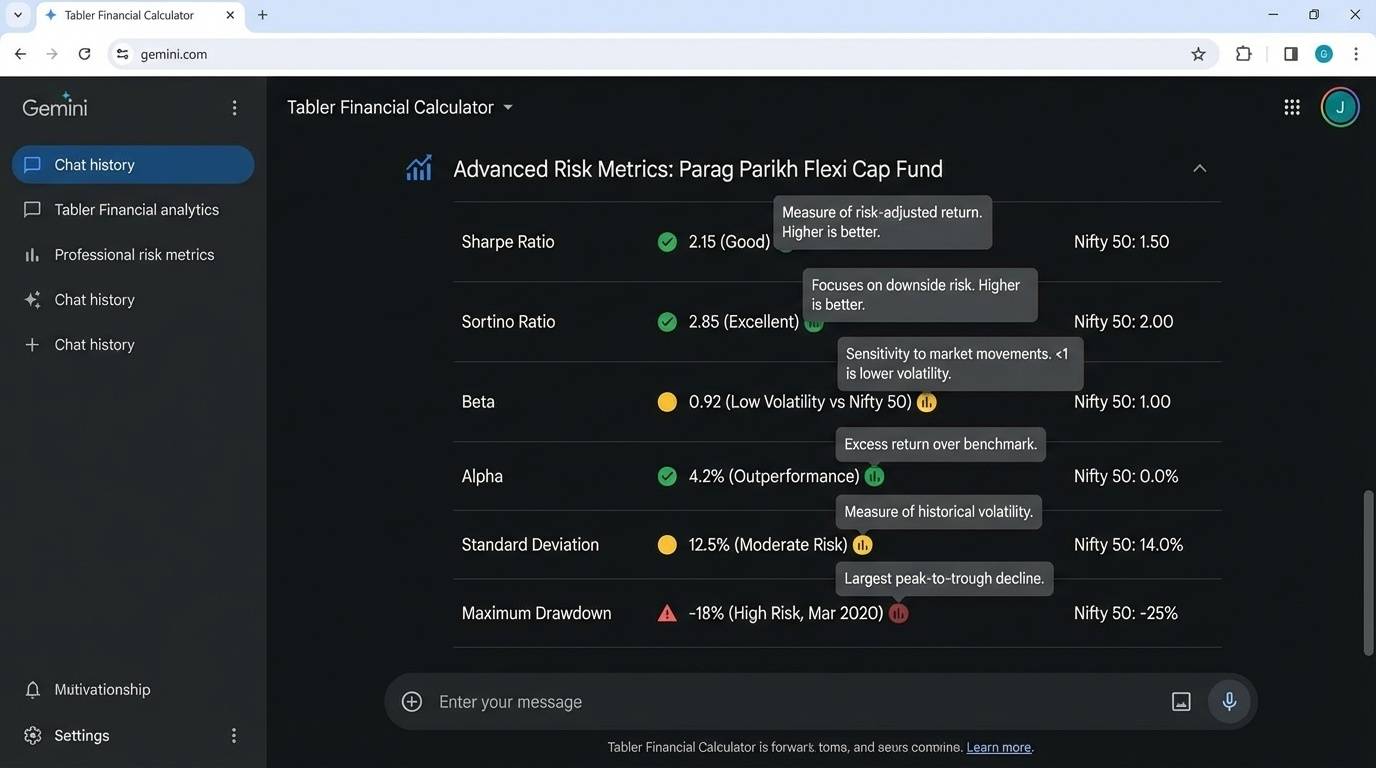
When I analyze Indian mutual funds using Gemini AI, I focus heavily on understanding how different fund categories behave during market stress. My go-to prompt for volatility analysis starts with asking Gemini to examine rolling standard deviation patterns across equity, debt, and hybrid fund categories over the past 5-7 years.
I typically use this prompt structure: “Analyze the monthly rolling volatility patterns for large-cap, mid-cap, small-cap, and sectoral funds in the Indian market from 2019-2024. Compare their volatility clustering during major market events like COVID-19, Russia-Ukraine conflict, and recent inflation cycles.”
What makes this approach powerful is asking Gemini to identify specific volatility regimes. I request it to categorize periods into low, medium, and high volatility environments, then analyze how different fund categories performed during each regime. This helps me understand which fund types offer better risk-adjusted returns during turbulent times.
My favorite follow-up prompt involves asking Gemini to create volatility heatmaps showing seasonal patterns. Indian markets often show distinct volatility patterns during monsoon seasons, festival periods, and budget announcements. By identifying these patterns, I can better time my mutual fund investments and rebalancing activities.
Correlation analysis for optimal portfolio diversification
Portfolio diversification becomes much more effective when I use Gemini AI for correlation analysis across Indian mutual fund categories. My primary prompt focuses on dynamic correlation patterns rather than static correlation coefficients.
I ask Gemini: “Calculate rolling 12-month correlations between large-cap equity funds, debt funds, international funds, and gold ETFs in Indian markets. Identify periods when correlations spiked above 0.7 and analyze the underlying market conditions.”
This approach reveals critical insights about diversification breakdown during crisis periods. I’ve learned that correlations between seemingly different asset classes often converge during market stress, making true diversification challenging. Gemini helps me identify which fund combinations maintain lower correlations even during volatile periods.
My advanced correlation prompt involves sector-wise analysis: “Examine cross-correlations between banking, pharma, IT, and FMCG sectoral funds over different market cycles. Highlight which sector combinations provide the most consistent diversification benefits.”
Through these prompts, I discovered that certain sector combinations like pharma-IT or banking-FMCG maintain relatively stable low correlations, making them excellent diversification pairs for Indian portfolios.
Stress testing scenarios for economic downturns
Stress testing my mutual fund portfolios using Gemini AI has become an essential part of my investment process. I create scenario-based prompts that simulate various economic downturns and their impact on different fund categories.
My primary stress testing prompt reads: “Model the performance of Indian equity, debt, and hybrid mutual funds during three scenarios: 1) 30% market correction over 6 months, 2) Rising interest rate environment with 200 basis points increase, 3) Currency depreciation of 15% against USD. Show maximum drawdowns and recovery periods for each category.”
I also focus on sector-specific stress tests by asking Gemini to analyze how sectoral funds perform during industry-specific crises. For instance, “Simulate the impact of banking sector NPAs rising to 12% on banking mutual funds, and analyze historical precedents from 2018 NBFC crisis.”
What’s particularly valuable is asking Gemini to stress test correlation breakdowns. During the 2008 financial crisis and COVID-19, many asset classes that were supposed to provide diversification failed simultaneously. My prompt for this analysis: “Identify scenarios where correlations between Indian equity funds and international funds exceeded 0.8, and calculate the impact on a diversified portfolio during these periods.”
These stress testing prompts help me build more resilient portfolios by understanding worst-case scenarios and preparing appropriate hedging strategies using different mutual fund categories and allocation adjustments.
Regulatory and Tax Efficiency Research Methods
SEBI Compliance Monitoring for Fund Houses
I’ve learned that tracking SEBI compliance is critical when researching Indian mutual funds, and Gemini AI can help me stay on top of regulatory changes that affect my investments. Here are the prompts I use to monitor compliance issues:
“What recent SEBI circulars or regulatory changes in the last 6 months could impact [specific fund house name] and their fund offerings?”
This prompt helps me catch regulatory shifts that might affect fund performance or operations. I also ask Gemini to explain how these changes translate into real-world implications for my portfolio.
“Analyze the compliance history of [AMC name] over the past 3 years. Include any penalties, warnings, or regulatory actions by SEBI.”
This gives me insights into the fund house’s regulatory track record. Clean compliance records often indicate better fund management practices.
“Compare the SEBI compliance scores and regulatory standings of the top 5 AMCs managing large-cap equity funds.”
I use this for comparative analysis when choosing between similar funds from different houses.
Tax-Saving Fund Optimization Strategies
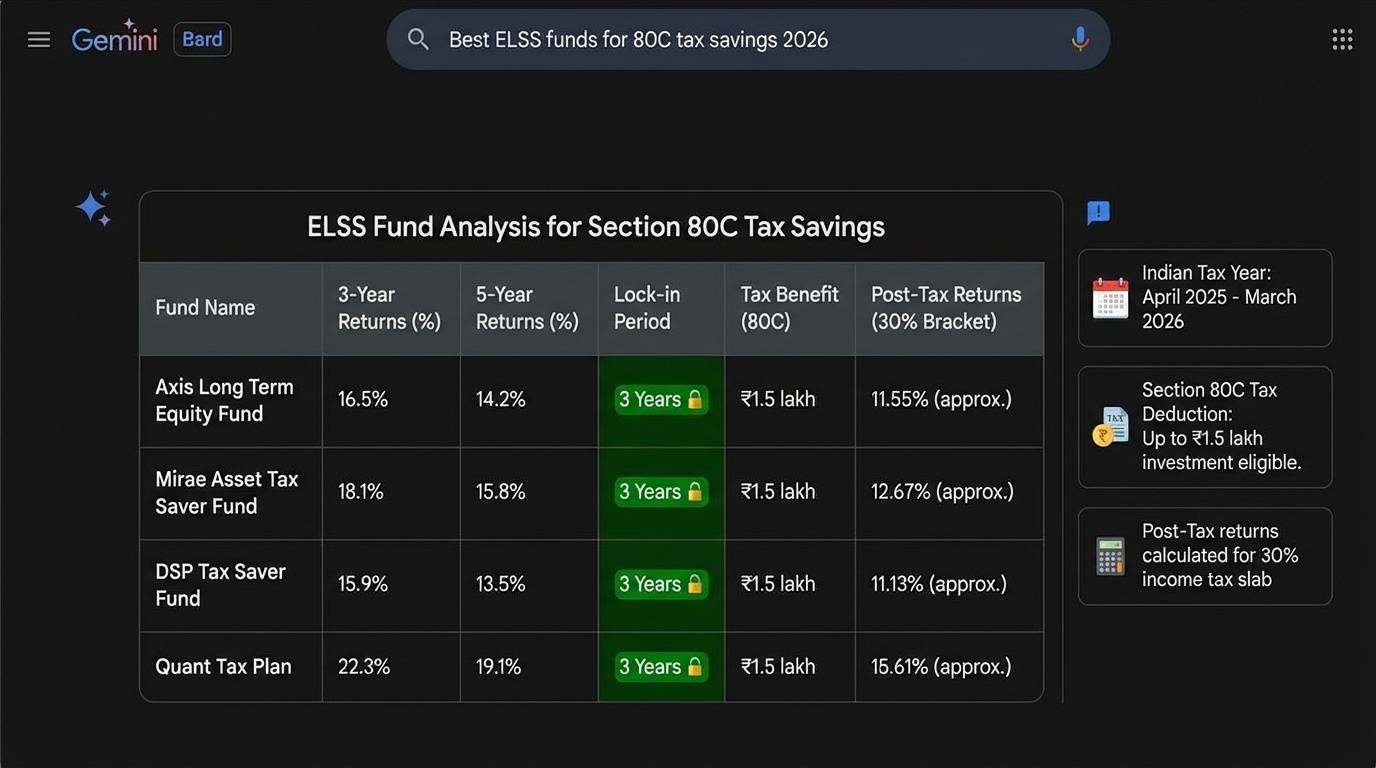
My approach to ELSS fund research through Gemini focuses on maximizing tax efficiency while achieving growth. Here’s how I structure my queries:
“Compare the 3-year rolling returns of top-performing ELSS funds with their tax-adjusted returns for someone in the 30% tax bracket.”
This prompt helps me understand the real value proposition after considering tax benefits.
“What’s the optimal investment strategy for ELSS funds considering the 3-year lock-in period and current market conditions heading into 2026?”
I ask Gemini to factor in market cycles and timing considerations for tax-saving investments.
“Analyze the sector allocation and portfolio overlap among the top 10 ELSS funds to identify diversification opportunities.”
This prevents me from inadvertently concentrating my tax-saving investments in similar holdings across multiple ELSS funds.
Exit Load and Expense Structure Analysis
Understanding costs is where I save real money, and these Gemini prompts help me dig deep into fund expenses:
“Break down the total cost of ownership for [fund name] including expense ratio, exit loads, and any hidden charges over a 5-year investment horizon.”
This comprehensive cost analysis reveals the true impact of fees on my returns.
“Compare the expense ratios of direct versus regular plans for [fund category] and calculate the difference in returns over 10 years on a ₹1 lakh investment.”
The results always reinforce why I choose direct plans whenever possible.
“Which funds in the [specific category] have recently reduced their expense ratios, and what prompted these changes?”
Market competition sometimes drives down costs, and I want to benefit from these trends.
Dividend Versus Growth Option Evaluation
My decision between dividend and growth options depends on my financial goals and tax situation. Here’s how I use Gemini for this analysis:
“Calculate the tax implications of dividend payouts versus growth option for [fund name] for investors in different tax brackets over a 7-year period.”
This helps me understand which option works better for my specific tax situation.
“What’s the reinvestment efficiency of dividend options versus growth options for [fund name] considering current dividend distribution tax rules?”
I need to factor in the tax treatment of dividends and how that affects compounding.
“Analyze the dividend payment history and consistency of [fund name] over the past 10 years. How does this compare to the growth option’s performance?”
This gives me insights into the fund’s dividend policy and whether it’s reliable for income planning.
Advanced Screening Techniques for 2026 Investment Landscape

ESG Compliance Scoring for Sustainable Investing
I’ve found that screening for ESG-compliant mutual funds requires sophisticated Gemini prompts that go beyond surface-level metrics. My approach focuses on creating AI-powered investment queries that dig deep into environmental, social, and governance factors specific to Indian markets.
When I craft Gemini prompts for mutual fund research, I start with this comprehensive query: “Analyze the ESG scoring methodology for [Fund Name] and compare it against SEBI’s sustainable finance guidelines. Evaluate portfolio holdings for carbon footprint, water usage efficiency, and board diversity metrics specific to Indian corporate governance standards.”
I’ve developed a scoring framework that helps me evaluate funds based on three key ESG pillars:
| ESG Factor | Evaluation Criteria | Gemini Prompt Focus |
|---|---|---|
| Environmental | Carbon emissions, renewable energy exposure | “Calculate carbon intensity ratios for portfolio companies” |
| Social | Employee welfare, community impact | “Assess labor practices and CSR spend allocation” |
| Governance | Board independence, audit quality | “Evaluate promoter shareholding patterns and transparency scores” |
My favorite AI-powered fund research prompt for ESG screening combines multiple data points: “Create a comprehensive ESG risk matrix for Indian equity funds, weighing environmental compliance against recent regulatory changes, social impact scores from recognized ESG rating agencies, and governance quality based on shareholder protection measures.”
Technology Adoption Impact on Traditional Sectors
The digital transformation sweeping through India’s traditional sectors creates unique investment opportunities that I track using targeted Gemini AI investment queries. My research focuses on how technology disruption affects mutual fund portfolios across banking, manufacturing, and retail sectors.
I use this specific prompt to evaluate tech adoption impact: “Analyze mutual fund holdings in traditional Indian banks versus digital-first financial services. Compare revenue growth, cost-to-income ratios, and customer acquisition costs to project which funds will benefit most from fintech disruption over the next 24 months.”
My screening process examines three transformation waves:
Digital Banking Revolution: I prompt Gemini to assess which banking-focused funds have optimal exposure to digital payment systems, neo-banking platforms, and API-based financial services
Manufacturing 4.0: My queries focus on funds with holdings in companies adopting IoT, automation, and supply chain digitization
Retail Technology Integration: I analyze funds exposed to e-commerce enablers, omnichannel retail, and consumer tech platforms
The most effective prompt I use combines sector analysis with timeline projections: “Evaluate mutual fund performance correlation with technology adoption scores across portfolio companies. Identify funds positioned to capture value from digital transformation in traditional Indian industries between 2024-2026.”
Inflation-Adjusted Return Projections
Creating accurate inflation-adjusted return projections using Gemini requires sophisticated prompting that accounts for India’s complex inflation patterns. My approach combines historical data analysis with forward-looking economic indicators to generate realistic return expectations.
I start with this foundational prompt: “Calculate real returns for Indian equity mutual funds over rolling 5-year periods, adjusting for CPI inflation, WPI variations, and sector-specific price indices. Project real return expectations for 2026 based on current monetary policy trajectory and fiscal spending patterns.”
My projection methodology includes these key components:
Base Case Scenarios: I prompt Gemini to model 6-8% nominal returns against 4-5% inflation expectations
Stress Testing: My queries incorporate higher inflation scenarios (7-9%) to test fund resilience
Sector Adjustments: I analyze how different sectors respond to inflationary pressures
The most valuable insight comes from this comparative prompt: “Generate inflation-adjusted return projections for large-cap versus mid-cap Indian funds, factoring in pricing power differences, input cost sensitivity, and historical performance during high-inflation periods.”
I’ve learned that combining multiple inflation measures provides better accuracy. My comprehensive prompt reads: “Project real returns for [Fund Category] using weighted average of CPI, core inflation, and asset-specific price indices. Include Monte Carlo simulations for different inflation scenarios through 2026.”

Currency Hedging Effectiveness for International Funds
Evaluating currency hedging strategies for international mutual funds requires nuanced Gemini AI investment queries that account for rupee volatility patterns and global currency dynamics. My research methodology focuses on hedging cost-benefit analysis across different international exposure strategies.
I use this detailed prompt to assess hedging effectiveness: “Analyze currency hedging performance for Indian international funds over the past 3 years. Compare hedged versus unhedged returns, calculate hedging costs as percentage of NAV, and evaluate timing effectiveness of hedge adjustments during major currency movements.”
My evaluation framework covers these critical aspects:
Hedging Cost Analysis:
I prompt Gemini to calculate annual hedging costs as percentage of fund returns
Compare hedging premiums across different base currencies (USD, EUR, GBP)
Evaluate opportunity costs of hedged positions during favorable currency movements
Volatility Impact Assessment:
My specialized prompt reads: “Measure volatility reduction achieved through currency hedging for Indian international funds. Calculate Sharpe ratios for hedged versus unhedged versions, and assess downside protection during rupee depreciation cycles.”
Dynamic Hedging Evaluation:
I analyze funds using adaptive hedging strategies with this query: “Evaluate dynamic currency hedging approaches used by Indian international funds. Assess hedge ratio adjustments based on volatility forecasts, interest rate differentials, and technical indicators.”
The most comprehensive assessment combines multiple timeframes: “Generate hedging effectiveness scores for international funds across different market cycles – bull markets, bear markets, and high volatility periods. Project optimal hedging strategies for 2026 based on expected USD-INR trading ranges and global monetary policy divergence.”

After diving deep into Gemini AI’s potential for mutual fund research, I’ve discovered that the right prompts can transform how we approach investment decisions in India’s dynamic market. From evaluating fund performance and analyzing market trends to assessing risk profiles and understanding regulatory changes, these AI-powered queries give me the tools to make more informed choices. The ability to quickly screen funds, research AMCs, and optimize for tax efficiency means I can spend less time gathering data and more time making strategic decisions.
As we head into 2026, the investment landscape will continue evolving rapidly, making AI assistance not just helpful but essential for staying competitive. I recommend starting with the basic performance evaluation prompts and gradually incorporating more advanced screening techniques as you become comfortable with the platform. The key is to treat Gemini as your research partner, not a replacement for your own judgment. With these prompts in your toolkit, you’ll be better equipped to navigate India’s mutual fund universe and build portfolios that align with your financial goals.
Disclaimer: This blog post is intended purely for educational and informational purposes to demonstrate AI research techniques for mutual fund analysis. Nothing in this article should be considered as personalized investment advice, and the author is not a SEBI-registered investment advisor. All mutual fund investments are subject to market risks, and investors should carefully read scheme documents and consult with qualified financial professionals before investing. AI-generated analysis should supplement, not replace, thorough due diligence and professional financial planning.