
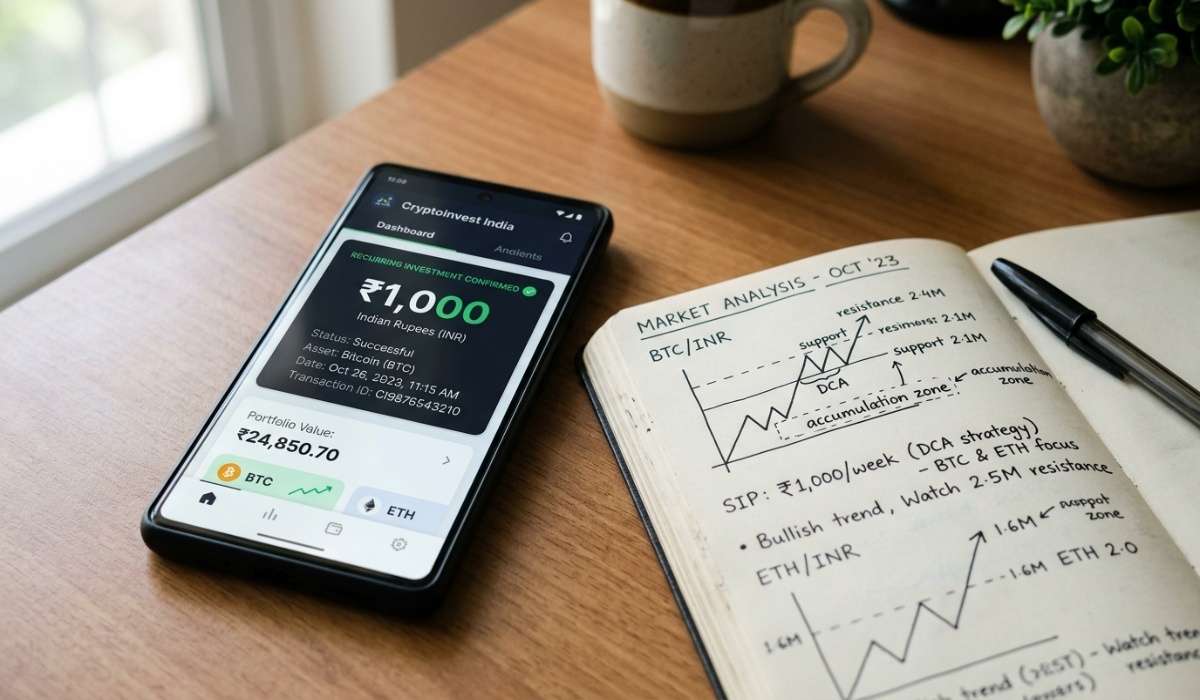
Most Indians already understand SIPs. You set aside ₹1,000 a month into a mutual fund, stay consistent, and let time do its thing. It’s boring in the best way. But what happens when you apply that same idea to Bitcoin, an asset that can swing 20% in a week?
That question is worth asking right now. India’s crypto user base has crossed 119 million. SIP adoption on platforms like CoinDCX jumped 600% since 2022. And yet, a 30% tax on gains, a 1% TDS on every trade, and Bitcoin’s notorious volatility make the whole thing feel risky in ways that a Nifty index fund never does. So the tension is real. You want in, but you’re not sure the math actually works in your favor.
This post breaks down whether rupee cost averaging genuinely tames Bitcoin’s wild price swings for Indian investors in 2026. You’ll see real performance data, understand the current tax and regulatory picture, and get a clear view of the risks that no platform will highlight on their signup page.
Understanding Crypto SIPs and the Power of Rupee Cost Averaging
What is a Crypto SIP and How it Works in India
Have you ever wished you could invest in Bitcoin without constantly worrying about whether it’s the “right time” to buy? That’s exactly what Crypto SIPs solve.
A Crypto Systematic Investment Plan works just like the mutual fund SIPs most Indians already know. You commit a fixed amount, say ₹1,000, and it gets invested automatically into cryptocurrencies like Bitcoin or Ethereum at regular intervals, weekly or monthly. The price doesn’t matter. The timing doesn’t matter. You just keep buying consistently.
I’ve seen friends paralyzed by Bitcoin’s wild price swings, waiting for the “perfect entry point” that never comes. They watch from the sidelines as prices move up and down. A Crypto SIP removes that paralysis completely. You’re not trying to outsmart the market. You’re just showing up regularly.
The entry barrier is remarkably low now. Indian platforms have made crypto SIPs accessible starting from just ₹500 to ₹1,000 per month. Platforms like Unocoin, Mudrex, CoinDCX, CoinSwitch, and ZebPay all offer automated SIP tools. You link your bank account, set your amount and frequency, and the system does the rest.
What makes this approach powerful is structure. Crypto has always been viewed as speculation, something for traders glued to screens. SIPs flip that narrative entirely. They shift the focus from short-term price movements to disciplined, long-term accumulation. You’re building a position over months and years, not chasing pumps.
From my years in financial planning at ICICI Prudential, I learned that consistency beats timing. Always. That principle works whether you’re buying equity mutual funds or Bitcoin. The technology behind crypto might be cutting-edge, but the investment discipline required is timeless.
Rupee Cost Averaging (RCA): Taming Bitcoin’s Volatility
Rupee Cost Averaging is the engine that makes Crypto SIPs work. It’s beautifully simple. When you invest ₹1,000 every month, you automatically buy more Bitcoin when prices drop and less when prices spike.

Let’s say Bitcoin costs ₹40 lakh in January. Your ₹1,000 buys 0.00025 BTC. Next month, the price crashes to ₹30 lakh. Same ₹1,000 now buys 0.000333 BTC. You’ve just bought more units for the same money. Over time, this smooths out your average purchase cost and reduces the impact of volatility.
I’ve watched Bitcoin swing 20-30% in a single week more times than I can count during my five years in crypto. Trying to time those moves is exceptionally difficult, even for professionals. RCA takes that pressure off completely. You’re not predicting. You’re averaging.
The data backs this up strongly. Unocoin’s research shows that SIP users experienced 20-25% lower portfolio volatility over 6-12 months compared to those who invested lump sums. That’s a massive difference in peace of mind.
Want a real example? Consider a ₹1,000 monthly SIP in Bitcoin from January 2015 to December 2025. Your total investment would be ₹1.32 lakh over 132 months. The value of that portfolio, depending on market conditions, could have grown to roughly ₹1.2-1.8 crore. That’s the power of consistency meeting an appreciating asset.
The psychological benefit matters just as much as the mathematical one. RCA transforms crypto from a gamble into a systematic approach. When prices crash, you’re not panicking because you know your next SIP will buy more. Market dips become opportunities, not disasters. That mindset shift is invaluable.
The Growing Appetite for Crypto SIPs in India (2025-2026 Trends)
Something remarkable happened in India’s crypto space during 2025. The SIP adoption rate surged over 60% year-on-year. This isn’t hype. It’s a fundamental shift in how Indians approach digital assets.
CoinDCX alone added over 572,000 new SIPs, a staggering 600% increase since 2022. Those numbers tell a clear story: investors want structure and discipline, not wild speculation.

The ticket sizes are growing too. On Mudrex, the average monthly SIP contribution jumped from under ₹500 to ₹4,000-₹6,000 by December 2025. People are getting more comfortable allocating meaningful amounts once they understand the strategy. That’s increasing investor confidence in action.
Who’s driving this shift? Young Indians, primarily in the 23-34 age group. They grew up with smartphones and UPI payments. Recurring digital investments feel natural to them. But they’re also cautious about risk, which is why the SIP model appeals more than lump-sum speculation.
India now has approximately 119 million active crypto users as of 2025. Projections suggest this will reach 123 million by the end of 2026. We’re genuinely a global leader in grassroots crypto adoption, not just in absolute numbers but in the democratization of access.
The secret sauce is accessibility. When you can start with ₹100-₹500 monthly investments, crypto becomes feasible for retail and first-time investors. This aligns perfectly with India’s UPI-led payment culture where small, frequent digital transactions are already the norm. The infrastructure for micro-investing was already built; crypto platforms just plugged into it intelligently.
Navigating the Indian Crypto Landscape: Regulations, Risks, and the Future
India’s Evolving Crypto Regulatory Framework in 2026
If you’ve been investing in crypto through SIPs in India, there’s one uncomfortable truth you must face. The regulatory ground beneath your feet is still shifting. Not wildly, but steadily.
The Union Budget for 2026-27 kept crypto taxes unchanged. That’s actually a relief. The 30% flat tax on gains from crypto transactions remains in place, along with the 1% Tax Deducted at Source (TDS) on every trade. Many investors had feared harsher measures. Instead, the government chose continuity.
But continuity doesn’t mean comfort. New penalty frameworks took effect on April 1, 2026, and they’re worth paying attention to. Miss filing your crypto transaction statement? You’ll pay ₹200 per day until you do. Submit inaccurate information? That’s a flat ₹50,000 penalty, no questions asked. The message is clear: the government wants transparency, and it’s willing to fine you for non-compliance.
Beyond taxes, the Financial Intelligence Unit (FIU-IND) has expanded its oversight of crypto exchanges. This means tighter Know Your Customer (KYC) and Anti-Money Laundering (AML) compliance. Every legitimate platform now demands identity verification, transaction monitoring, and detailed records. The intent is to reduce fraud and misuse, but for investors, it also means choosing platforms carefully.
Globally, crypto regulation is shifting from “containment to coordination.” Countries are recognizing that outright bans don’t work.
 India, home to roughly 119 million active crypto users in 2025 and projected to hit 123 million by the end of 2026, can’t afford to stay on the sidelines. The government is expected to revisit its stance as participation deepens and becomes more structured.
What does this mean for you as a crypto SIP investor? Simple. Mandatory record-keeping is non-negotiable. You need platforms that offer clear transaction exports and tax-ready statements. Manual tracking is painful and error-prone. Platforms like ZebPay emphasize compliance and transparency, making tax filing smoother. Don’t underestimate this. A ₹50,000 penalty can wipe out months of disciplined SIP gains.
Benefits of Crypto SIPs Beyond RCA: Diversification and Discipline
Let me be honest. The biggest benefit of crypto SIPs isn’t just rupee cost averaging. It’s discipline.
I’ve watched investors buy Bitcoin at ₹35 lakh during euphoria, only to sell at ₹25 lakh in panic. Crypto SIPs force a different behavior. You invest the same amount every month, regardless of headlines, Twitter hype, or market crashes. This removes emotion from the equation. You’re not trying to time the market. You’re building a position systematically.
This discipline helps you avoid two costly mistakes. First, emotional buying during hype cycles when everyone’s talking about crypto. Second, panic selling during dips when fear dominates the conversation. Both behaviors destroy wealth.
 Automation is your shield.
Crypto SIPs also offer portfolio diversification. Many new participants come from equities and commodities backgrounds, treating digital assets as a diversification tool. This makes sense. Bitcoin’s price movements don’t always mirror stock indices or gold. A diversified portfolio spreads risk.
Automated SIP tools reduce manual errors. Forgetting to invest or delaying decisions can cost you. When Bitcoin dips 20% in a week, hesitation feels rational. But that’s exactly when SIPs shine, automatically executing your buy order. Consistency beats cleverness in volatile markets.
Another underappreciated benefit: institutional participation in India’s crypto ecosystem is growing. This improves liquidity, market depth, and infrastructure maturity. Better liquidity means tighter spreads and easier entry or exit. Infrastructure maturity means fewer platform crashes during high volatility. These improvements benefit retail SIP users directly.
For those seeking to integrate crypto into a broader financial strategy, understanding these benefits is crucial. Resources like Paisa Forever’s financial planning advice can help you decide what percentage of your portfolio should be in crypto, based on your risk tolerance and goals. Don’t treat crypto SIPs as a standalone gamble. Treat them as one component of a diversified, long-term wealth-building plan.
Key Risks and Considerations for Indian Crypto SIP Investors
Now for the uncomfortable part. Risks.
High Volatility: Bitcoin is not a mutual fund. A 20% swing in a month is normal. A 50% crash is rare but possible. Traditional assets like mutual funds move slower. Crypto moves fast. If you panic when your portfolio drops 30%, crypto SIPs aren’t for you.
Regulatory Uncertainty: India’s crypto regulations are evolving, not settled. The current framework is functional but not comprehensive. Future policy changes could impact taxation, platform operations, or even asset legality. This uncertainty is a risk you must acknowledge.
Tax Friction: The 1% TDS applies to transaction value, not profit. If you invest ₹10,000, the platform deducts ₹100 as TDS upfront. Over time, this creates cashflow friction, especially for frequent traders. Worse, crypto losses generally cannot be set off against other income. This penalizes over-trading and short-term speculation. SIPs reduce this friction by focusing on long-term accumulation, but the tax structure still bites.
Platform Trustworthiness: Not all crypto exchanges are equal. Choose platforms with strong KYC/AML compliance, transparent transaction history, clear fee disclosures, and reliable tax records. A platform failure or fraud can wipe out your investment. Do your homework.
Not a Guaranteed Return: Crypto SIPs manage volatility. They don’t eliminate risk. Past performance, like the ₹1,000 monthly SIP growing from ₹1.32 lakh to ₹1.2-1.8 crore between 2015 and 2025, is impressive but not guaranteed. Bitcoin could underperform for years. You need a long time horizon and money you can afford to lose.
Staying informed is your best defense. Reliable crypto updates, like those provided by Paisa Forever, help you navigate these risks and make strategic investment choices. Don’t invest blindly. Educate yourself continuously.
Also Read: Lithium Investing India 2026: What Nobody Tells You
Disclaimer: Investment in cryptocurrencies is subject to high market volatility, extreme price swings, and evolving regulatory conditions within India. This content is prepared solely for informational and educational purposes and does not constitute formal financial, legal, or tax advice. Readers must conduct independent research, review platform compliance structures, and consult a certified financial planner before allocating capital to digital assets.