

Why do so many Indian investors feel left out when a massive global wealth creation event happens? Just a few days ago, my phone blew up with messages from friends and blog readers alike. Everyone was asking the exact same question: After SpaceX’s bumper listing, can Indian investors subscribe to IPOs from USA? It is a fair question. When a monumental company goes public, the fear of missing out (FOMO) is completely natural. However, the international stock market operates very differently from our domestic exchanges like the BSE and NSE. In my 14 years of investing and my time working in the financial sector, I have seen countless retail investors jump into complex foreign investments without understanding the structural barriers, hidden costs, or tax rules.
In this comprehensive guide, I am going to break down exactly what happened with the SpaceX IPO and answer whether you can actually get in on the ground floor of American public offerings. You will learn the reality of cross-border investing, how the Reserve Bank of India (RBI) regulates your foreign investments, and the exact steps you must take to legally and safely buy U.S. stocks. Let’s dive in.
SpaceX Nasdaq Debut & The India Question
The financial world witnessed history on June 12, 2026. SpaceX officially debuted on the Nasdaq stock exchange. It was not just a regular listing; it was a staggering $75 billion Initial Public Offering (IPO)—officially the largest in global market history.
For Indian retail investors who have spent years following Elon Musk’s rocket launches and the global rollout of Starlink internet, this felt like a once-in-a-generation opportunity. But as the headlines rolled in, a frustrating reality set in for many retail participants sitting in Mumbai, Bengaluru, or Delhi.
This brings us to the central question I want to address today: After SpaceX’s Bumper Listing, Can Indian Investors Subscribe to IPOs from USA? Can you, as an everyday investor in India, actually get your hands on shares at the original IPO offer price, or are you forced to buy them later at a premium? Before we answer that, we need to understand what exactly investors are buying into.
SpaceX Background & Context

To understand the hype, we have to look at the foundation of the company. Founded in 2002 by Elon Musk, SpaceX started with a seemingly impossible goal: making life multi-planetary. Fast forward to today, and the company’s business model is a dominant force in the global space economy.
SpaceX generates its revenue through three main pillars:
- Commercial Space Launches: Using their reusable Falcon 9 rockets.
- Government Contracts: Multi-billion dollar partnerships with NASA.
- Starlink: A satellite broadband mega-constellation that provides internet globally and operates on a highly profitable recurring subscription model.
Furthermore, SpaceX recently integrated Musk’s artificial intelligence venture, xAI. This combination allows them to pair satellite networks with orbital AI data centers.
The success of this IPO did something else historic. By combining his newly valued equity in SpaceX with his existing holdings in Tesla and other ventures, Elon Musk officially became the world’s first trillionaire. It is a fascinating milestone, but as an investor, you must separate the hype from the actual financial data.
The IPO Financial Metrics
As a former financial professional at ICICI Prudential, I always tell my readers to look at the raw numbers. Hype does not generate returns; numbers do.
According to the official SEC filings, here are the key metrics from the SpaceX IPO:
- Offer Price: The shares were priced at a fixed $135 per share.
- Capital Raised: The company successfully raised around $75 billion.
- Trading Ticker: The stock was listed under the ticker symbol SPCX.
- Market Debut: On its first day of trading, the stock opened near $150 and closed the day roughly 19% to 20% higher, near the $160.95 mark.
This massive surge pushed SpaceX’s total market valuation to between $1.77 trillion and $2.0 trillion. While these numbers are phenomenal, they also highlight a crucial point for retail investors. The people who bought at $135 made an instant paper profit when the stock opened at $150. But were Indian retail investors able to get that $135 price?
The Direct Subscription Reality (IPO vs. Secondary Market)
Let us get straight to the facts. After SpaceX’s Bumper Listing, Can Indian Investors Subscribe to IPOs from USA? The direct and honest answer is: No, Indian retail investors generally cannot subscribe directly to U.S. IPOs. To understand why, you must understand the difference between the primary market and the secondary market.
- Primary Market (Direct IPO): This is the first public sale of shares. You buy directly from the company (via their underwriting banks) at the fixed offer price (e.g., $135 for SPCX).
- Secondary Market: This happens after the stock is officially listed on the exchange. You buy shares from other investors at the fluctuating market price (e.g., $150 or $160 for SPCX).
Indian retail investors are strictly limited to the secondary market. Direct U.S. IPO access is heavily restricted and typically unavailable on the retail broker platforms that operate in India.
Structural Barriers to IPO Access
Why are we locked out? In India, the Securities and Exchange Board of India (SEBI) has designed a highly democratic system called ASBA (Application Supported by Blocked Amount). Under ASBA, a mandated percentage of every Indian IPO is reserved specifically for retail investors.
The U.S. market does not have this retail quota system. The U.S. IPO book-building process is managed by underwriting banks (like Goldman Sachs or Morgan Stanley). These banks allocate the primary shares overwhelmingly to their preferred clients—which means domestic institutional investors, hedge funds, and massive wealth management clients.
During my 5+ years at ICICI Prudential, I saw firsthand how institutional capital operates. The big players get the first bite of the apple. Global brokers accessible from India, like Interactive Brokers, strictly limit IPO allocations to specific regional entities (like IBKR LLC, Hong Kong, or Singapore), completely bypassing Indian retail clients. Indian-focused platforms like Vested or INDmoney explicitly state on their platforms that direct IPO subscription is “not possible yet.”
Funding via RBI’s Liberalised Remittance Scheme (LRS)
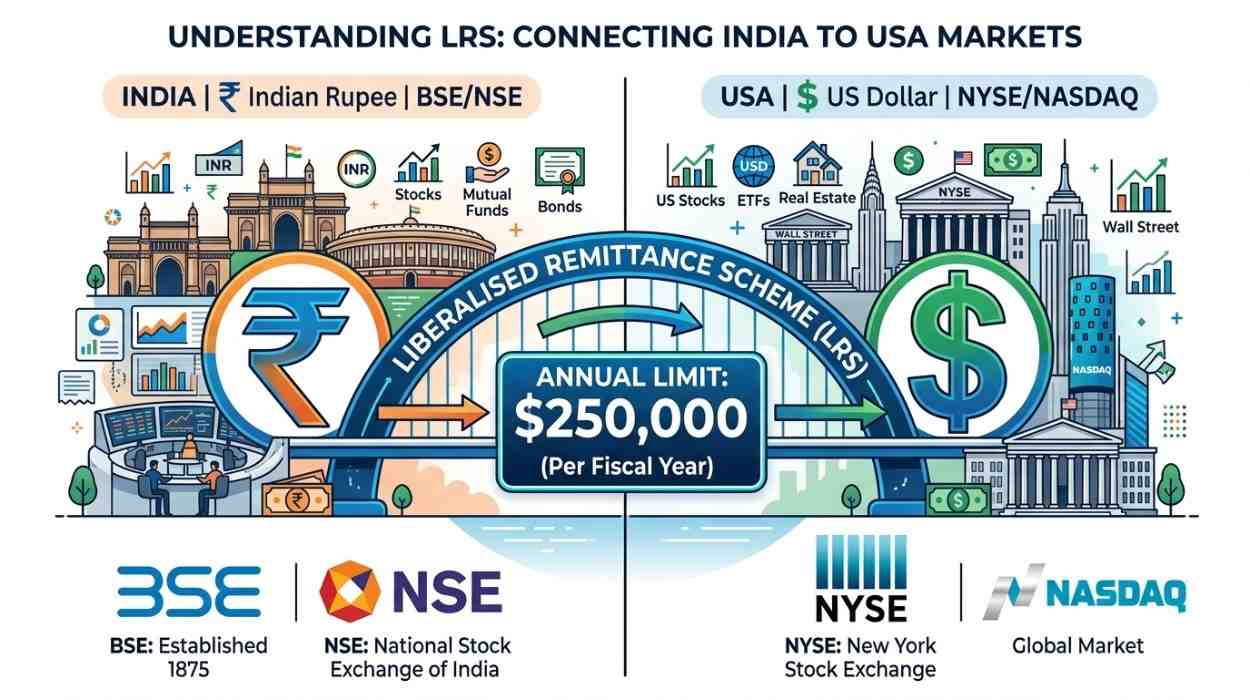
Since you cannot buy at the IPO stage, you must buy the shares on the secondary market once they begin trading. But sending money from your Indian bank account to a U.S. brokerage account involves strict regulations.
This is governed by the Reserve Bank of India’s Liberalised Remittance Scheme (LRS).
As per RBI guidelines, the LRS permits resident individuals to remit up to $250,000 per financial year for permissible current or capital account transactions, which includes buying overseas equity.
When you fund your U.S. brokerage account, you are doing an outward remittance. It is important to note that a Tax Collected at Source (TCS) applies to remittances above ₹7 lakh in a financial year. This is not a tax penalty; you can claim this TCS back as a credit against your overall tax liability when you file your Income Tax Return.
Step-by-Step Purchasing Process
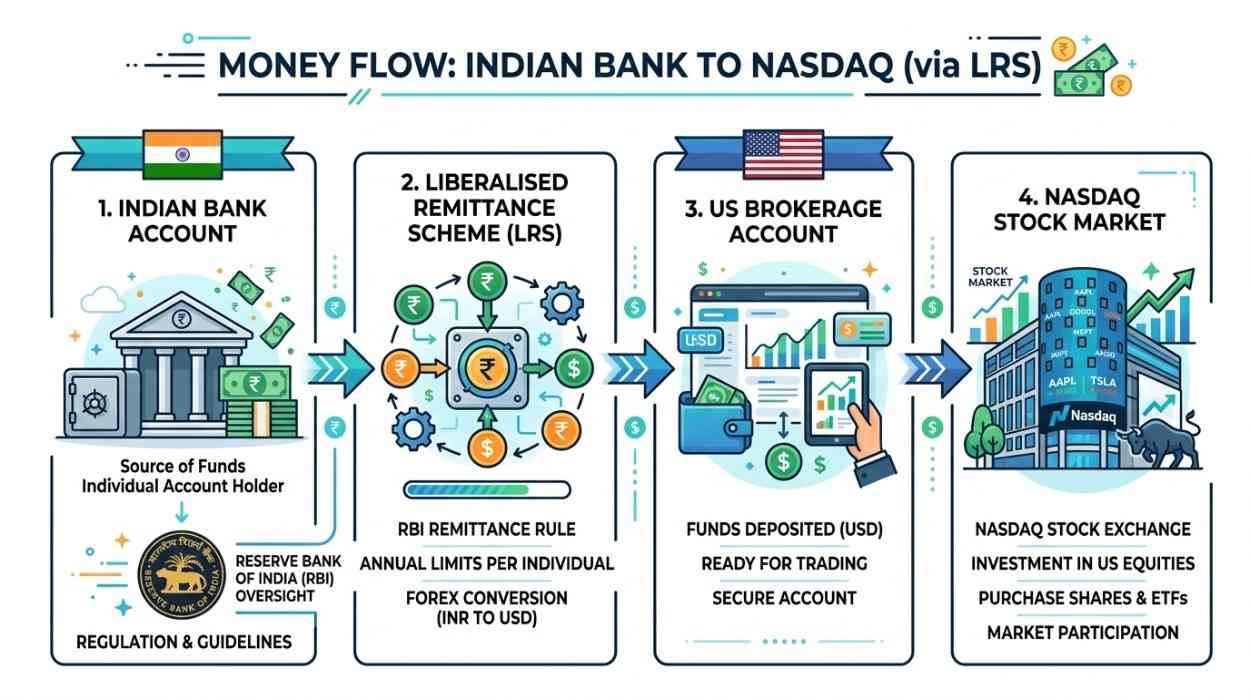
If you have decided you want to add SPCX (or any other U.S. stock) to your portfolio for long-term portfolio diversification, the process is actually quite straightforward today.
Here is the exact step-by-step framework I recommend:
- Choose a Platform: Select a regulated platform that facilitates U.S. investing. Popular options include Vested, INDmoney, Groww, or navigating through GIFT City platforms like India INX Global Access.
- Complete International KYC: You will need to provide your PAN card, Aadhaar card, and a bank statement to comply with anti-money laundering laws.
- Fund via LRS: Transfer Indian Rupees (INR) from your bank to your brokerage’s designated partner bank. The platform will convert your INR to USD at the prevailing exchange rate (plus a forex markup fee).
- Search and Buy: Once your USD wallet is funded, search for the ticker symbol (e.g., SPCX).
- Use Fractional Investing: The beauty of the U.S. market is fractional shares. If a stock costs $150, you do not need to buy a whole share. You can invest exactly $10 or $50 and own a fraction of that share.
U.S. Tax Compliance (Form W-8BEN)
Investing across borders means dealing with the tax authorities of two different countries.
As a non-U.S. citizen investing in U.S. markets, you are subject to IRS (Internal Revenue Service) regulations. However, you do not have to pay U.S. capital gains taxes. To ensure you are exempted from U.S. capital gains tax, you must complete Form W-8BEN.
Form W-8BEN establishes your status as a foreign investor. Most modern brokerage apps handle this form digitally during your account setup. Furthermore, India and the U.S. have a Double Taxation Avoidance Agreement (DTAA). By submitting the W-8BEN, the U.S. withholding tax on any dividends you receive is reduced from the standard 30% down to 25%.
Costs, Taxes, and Market Risks
This is the most critical section of this article. Global investing is not free, and the tax implications in India are strict.
The Hidden Costs:
Every time you send money abroad, you pay a currency conversion fee (forex markup), which is usually between 1% to 2% of your capital. You must factor this into your expected CAGR (Compound Annual Growth Rate).
Indian Taxation:
According to Indian tax laws, foreign stocks are classified as “unlisted equity” because they are not listed on recognized Indian exchanges like the BSE or NSE.
- Long-Term Capital Gains (LTCG): If you hold the U.S. stock for more than 24 months, your profits are taxed at a flat 12.5%.
- Short-Term Capital Gains (STCG): If you sell before 24 months, the profits are added to your regular income and taxed at your applicable income tax slab rate.
The Schedule FA Trap:
This is where I see investors make massive mistakes. If you hold even a single fraction of a U.S. share, you are legally mandated to declare it in Schedule FA (Foreign Assets) when filing your Indian Income Tax Return (ITR-2 or ITR-3). Failing to disclose foreign assets can attract a brutal penalty of up to ₹10 lakh under the Black Money Act, even if your total investment is tiny.
Market Risks:
Never forget that newly listed IPOs are highly volatile. The U.S. SEC regularly warns that early trading days for IPOs experience wild price swings. Just because a stock opens 20% higher does not mean it cannot crash 30% the next week.
Investment Discipline & Outlook
In my 10+ years actively trading and investing in the Indian stock markets, I have learned one absolute truth: Discipline always beats hype.
You should never buy a stock—whether it is an Indian mid-cap or an American mega-cap like SpaceX—purely out of FOMO. U.S. equities are a fantastic tool for portfolio diversification, allowing you to hedge against currency depreciation and access global tech giants. However, they should fit into a well-thought-out financial plan alongside your domestic SIP mutual funds, your emergency fund, and your term insurance.
While you missed the $135 IPO price for SpaceX, setting up your global investment accounts today prepares you for the future. The technical setup you complete now ensures that when the next generational tech listings occur—like the highly anticipated public offerings for OpenAI or Anthropic—you will be ready to participate confidently on the secondary market.
Read: The Common Risks You Must Know Before Investing in the US Stock Markets
Key Takeaways
- No Direct IPO Access: Indian retail investors cannot directly subscribe to U.S. IPOs at the initial offer price; you must buy them on the secondary market post-listing.
- LRS is Mandatory: You can legally invest up to $250,000 per year in U.S. stocks using the RBI’s Liberalised Remittance Scheme via platforms like Vested or INDmoney.
- Strict Tax Compliance: You must file Form W-8BEN for U.S. tax exemptions, and you are legally required to declare all overseas holdings in Schedule FA of your Indian ITR to avoid severe penalties.
- Focus on Diversification: Treat U.S. stocks as a way to geographically diversify your portfolio, not as a get-rich-quick scheme chasing IPO hype.
As an investor, your greatest asset is informed decision-making. Don’t let the noise of the market distract you from the fundamentals of wealth creation. Set up your processes, understand the taxes, and invest with logic, not emotion. Happy investing!
Also Read: What happens to Indian stocks when the US Dollar weakens?
Disclaimer: The information provided in this blog post is strictly for educational and informational purposes only and does not constitute financial, investment, or legal advice; readers are strongly advised to consult a SEBI-registered investment advisor or a certified financial planner before making any cross-border investment decisions. Tax laws, RBI regulations, and LRS limits are subject to change, and the author cannot be held liable for any financial losses, penalties, or regulatory non-compliance arising from actions taken based on this content. Foreign equity investments carry significant market risk, currency risk, and regulatory risk, and past performance of any stock, including SPCX, is not indicative of future results.