

The Indian Rupee recently hit a staggering record low, crossing the ₹95 mark against the US dollar. If your entire portfolio is parked in domestic assets, your wealth might look perfectly fine on a local bank statement—but in real, global terms, it is steadily shrinking. That upcoming international vacation just got more expensive, and your child’s overseas education costs have quietly spiked. Because of ongoing Rupee Depreciation, the returns you earn in INR simply don’t stretch across borders the way they used to.
This is not an isolated incident, either. Since 1991, the Rupee has steadily lost ground, dropping by an average of roughly 4.5% per year against the greenback. Fast forward to 2026, and a combination of higher US interest rates, surging oil prices, and FPI outflows is pushing the currency even lower. For any investor with long-term goals tied to international spending, relying entirely on domestic investments presents a serious, tangible risk.
This is exactly why a growing number of Indian investors are actively pivoting to global ETFs. In this post, we will unpack the macroeconomic forces driving the Rupee’s slide, explain how it silently erodes your purchasing power, and show you how global ETFs can serve as a practical, protective hedge. Finally, we will walk you through the actual routes and current RBI regulations for adding these international funds to your portfolio.
The Indian Rupee’s Slide: Understanding the Drivers and Impact
Rupee at Record Lows: Key Causes in 2026
The Indian Rupee has been making headlines for all the wrong reasons. As of April 2026, it hovers between ₹91–93 per US dollar. At its worst, it touched a record low of ₹95 per USD, a level that would have seemed unthinkable just a few years ago.
What’s driving this weakness?
The US dollar’s strength is the first culprit. Higher interest rates in America make dollar-denominated assets far more attractive to global investors. Capital flows toward higher yields. This is basic economic gravity. When the US Federal Reserve keeps rates elevated, emerging market currencies like ours take a hit.
Then there’s crude oil. India imports roughly 85% of its oil needs. When global crude prices spike, our import bill balloons overnight. We need more dollars to pay for the same amount of oil, which means banks, refineries, and importers scramble to buy dollars in the foreign exchange market. This surge in demand puts relentless downward pressure on the Rupee.
Foreign Portfolio Investors (FPIs) have been pulling money out of Indian equities and debt markets. When they exit, they convert their Rupee holdings back to dollars. These persistent outflows add fuel to the depreciation fire. I’ve watched this pattern unfold multiple times during my 14+ years of investing, and it never gets less concerning.
Geopolitical tensions amplify the problem. Whenever global uncertainty spikes—whether it’s conflicts in the Middle East, trade wars, or political instability—investors rush to safety. The dollar, as the world’s reserve currency, becomes the safe haven. Emerging markets like India see capital flight. Our currency weakens further.
This isn’t a new phenomenon.
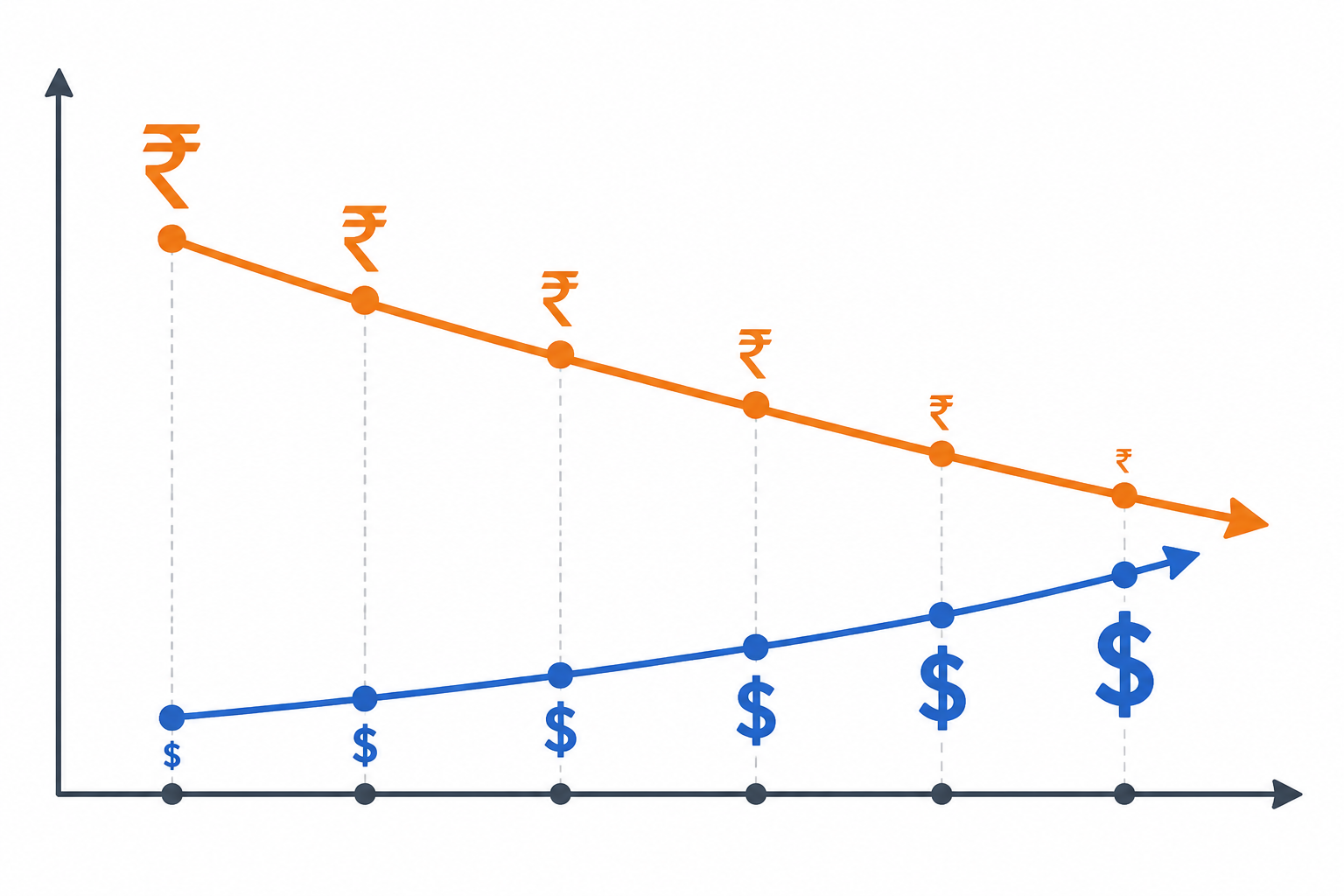 The Rupee has depreciated by approximately 4.5% annually against the dollar since 1991. That’s over three decades of steady erosion driven by inflation differentials, trade imbalances, and structural economic factors. The current crisis is severe, but the underlying trend has been consistent throughout my entire investing career.
The Silent Erosion: How Rupee Weakness Affects Your Wealth
Many investors don’t realize how Rupee depreciation quietly eats away at their wealth. The impact is real and immediate.
Imported goods cost more. Foreign travel becomes a luxury. International education for your children demands a significantly larger outlay in Rupees. Every time the Rupee weakens by ₹5 against the dollar, a $50,000 annual college tuition effectively increases by ₹2.5 lakh in your budget. That’s not inflation—that’s currency erosion.
Here’s what troubles me most.
 Your portfolio might show healthy nominal gains in Rupees. Perhaps your equity mutual funds are up 12% this year. Looks good, right? But adjust those returns for dollar performance, and the picture changes dramatically. If the Rupee has depreciated 8% in the same period, your real global purchasing power has grown by only about 4%. This silent erosion affects investors holding only domestic assets far more than they realize.
I’ve seen this firsthand with clients planning retirement abroad or parents saving for their children’s overseas education. The goalpost keeps moving. What seemed like adequate savings five years ago now falls short because the Rupee has weakened substantially.
The Reserve Bank of India does intervene. They sell dollars from forex reserves to stabilize the market during sharp falls. But the RBI generally allows the Rupee to move with market fundamentals. They manage volatility, not the long-term trend. You cannot rely on interventions to protect your wealth.
Understanding this dynamic changes how you plan. Currency fluctuations aren’t just macroeconomic abstractions. They directly impact whether you can afford that family vacation, fund your daughter’s MBA, or maintain your lifestyle in retirement. Effective financial planning must account for this reality and incorporate strategies that provide a natural hedge against persistent Rupee weakness.
Global ETFs: A Strategic Shield Against Currency Volatility
Diversification Beyond Borders: The Core Appeal of Global ETFs
I’ve seen too many investors put all their eggs in one geographic basket. They build solid portfolios, track their mutual funds religiously, watch stock prices daily. But they forget one critical thing. They’re 100% exposed to India.
When the Rupee hits ₹91 or ₹93 against the dollar, their entire wealth takes a hidden hit. This is where global ETFs become more than just another investment product. They become a strategic necessity.
What exactly are global ETFs? Think of them as baskets of international stocks or bonds that trade on exchanges, just like regular Indian stocks. You get instant exposure to companies like Apple, Microsoft, or European pharmaceutical giants. Companies that aren’t listed in India. Sectors that aren’t as developed here.
I started exploring global ETFs back in 2018, not because I lost faith in Indian markets. But because I understood a simple truth. Different economies peak and fall at different times. When India faces headwinds, the US might be thriving. When tech crashes in America, healthcare in Europe might stay resilient. This is geographic diversification at work.
The numbers tell the story clearly.
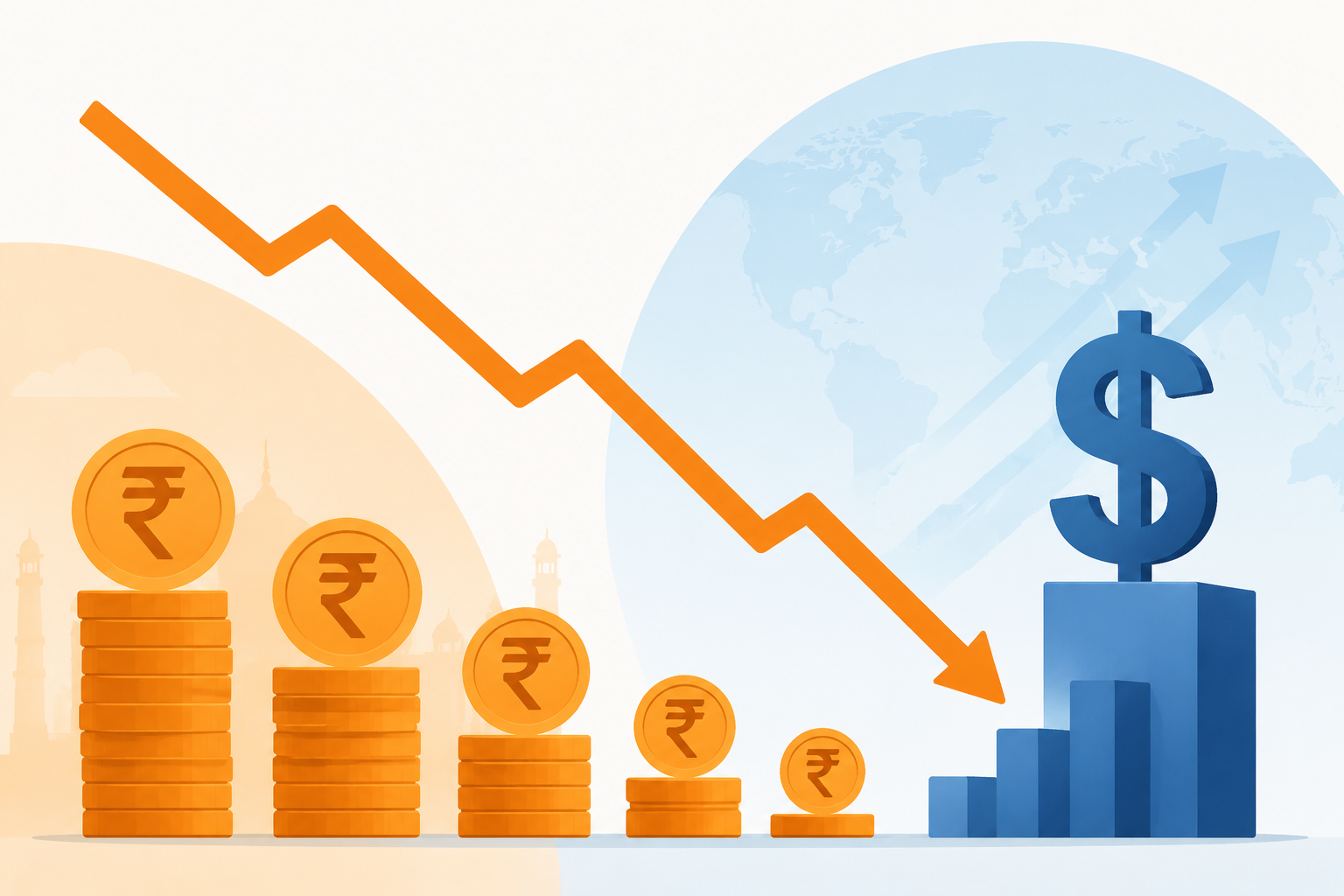 The Indian Rupee has depreciated roughly 4.5% annually against the dollar since 1991. If you held ₹10 lakhs in pure Indian assets a decade ago, your global purchasing power has shrunk significantly, even if your portfolio grew in INR terms.
Here’s where currency hedging becomes powerful. Let’s say you invest ₹1 lakh in a US-focused ETF when the Rupee is at ₹85 per dollar. That’s roughly $1,176. Fast forward to today. The Rupee touches ₹92. Even if the ETF’s dollar value stays flat, your INR value jumps to approximately ₹1.08 lakhs. You gain without the underlying assets moving. This natural hedge protects your wealth from Rupee erosion.
Global ETFs typically carry lower expense ratios than actively managed international mutual funds. I’ve seen expense ratios as low as 0.3% to 0.8% for global ETFs versus 1.5% to 2.5% for active international funds. Over 15-20 years, this cost difference compounds significantly in your favor.
During my time at ICICI Prudential, I noticed a clear pattern. Investors who maintained 15-20% allocation to global assets experienced smoother portfolio journeys. Their returns became less dependent on domestic political changes, monsoon predictions, or local inflation spikes. They tapped into global growth stories. AI. Clean energy. Biotech innovation. Sectors where India is still catching up.
Investing in Global ETFs from India: Routes and Regulations
The question I get most often is simple. “How do I actually buy these global ETFs from India?” The answer involves understanding two distinct pathways.

Route one is direct investment. You open an account with an international brokerage platform that accepts Indian residents. Names like Vested Finance, INDmoney, or Interactive Brokers come up frequently. The RBI’s Liberalised Remittance Scheme (LRS) allows you to remit up to $250,000 per financial year for overseas investments. That’s ₹2.3 crores at current rates. More than enough for most individual investors.
The documentation is straightforward. PAN card. Aadhaar. Bank account proof. The same KYC you’d do for any Indian broker. Once verified, you can buy ETFs listed on US exchanges (NYSE, NASDAQ) or European markets. You invest in dollars. Your returns come in dollars. The currency exposure is complete.
Route two is indirect investment through Fund of Funds (FoFs). These are Indian mutual funds or ETFs that pool your rupees and invest overseas on your behalf. You buy units in rupees. The fund manager handles the currency conversion, foreign regulations, and tax documentation. Much simpler for beginners.
I personally started with FoFs during my early exploration phase. The convenience factor is real. No forex headaches. No international tax forms. Just regular SIP or lump sum investments, exactly like domestic mutual funds.
But there’s a regulatory catch. SEBI imposes a collective $1 billion limit on Indian mutual funds investing in overseas ETFs. In March 2024, several AMCs had to temporarily stop accepting fresh investments when this limit was breached. This creates unpredictability. You might want to invest, but the fund could be closed for new money.
For those exploring FoFs, Paisa Forever’s mutual fund resources offer detailed comparisons of available options, tracking limits, and performance history. This helps you identify which funds are accepting investments and which align with your goals.
The choice between direct and indirect depends on your comfort level. Direct investment offers more control, wider choice, and potentially lower costs. Indirect investment via FoFs provides simplicity, regulatory compliance handled for you, and rupee-based transactions.
Maximizing Returns and Managing Risk: A Holistic Approach
Global ETFs are powerful tools. Not magic solutions.
I’ve seen investors jump into international ETFs without understanding what they own. They chase recent performance. They ignore expense ratios. They don’t check tracking errors, the difference between the ETF’s performance and its underlying index. This matters. A poorly managed ETF might lag its benchmark by 1-2% annually. That’s your return leaking away.
Due diligence starts with the basics. What index does the ETF track? Is it the S&P 500? NASDAQ 100? A global healthcare index? Understand the geographic and sectoral exposure. Read the fact sheet. Check the top 10 holdings. Are you comfortable owning these companies?
Expense ratios vary widely. Don’t assume all global ETFs are cheap. Compare across providers. A 0.5% difference might seem small. Over 20 years on a ₹10 lakh investment growing at 10% annually, that 0.5% costs you approximately ₹3 lakhs. Real money.
Tax implications deserve serious attention. This is where many investors stumble. Capital gains on international investments held directly are taxed differently than domestic equity. Dividends from foreign stocks face different withholding taxes. If you invest via FoFs, the tax treatment follows debt fund rules currently. Long-term capital gains taxed at your income slab after indexation (though recent changes have affected this). Short-term gains added to income. Know the rules. Plan accordingly. Factor in tax drag when calculating expected returns.
I maintain a simple rule from my 14+ years of mutual fund investing. Global allocation should fit your overall asset allocation, not dominate it. For most Indian investors, 10-20% in global assets makes sense. It provides diversification. It hedges currency risk. But it doesn’t bet the farm on foreign markets you might understand less intimately.
Rebalancing is non-negotiable. Markets move. Currency fluctuates. Your 15% global allocation might drift to 22% after a strong dollar rally and US market gains. Rebalance back to target. This forces you to sell high, buy low. Exactly what disciplined investing demands.
Regular portfolio reviews every six months help. Check performance. Verify the ETF still tracks its index properly. Ensure regulatory limits haven’t affected your FoFs. Stay updated on currency trends and global macro developments.
For comprehensive guidance on building diversified portfolios that integrate global ETFs strategically, Paisa Forever offers financial planning frameworks grounded in real-world data and long-term thinking. The goal isn’t quick riches. It’s building resilient wealth that survives currency storms, market crashes, and geographic shocks. Global ETFs, used wisely, become part of that foundation. Not the entire structure, but a critical support beam that strengthens everything else you’ve built.
Also Read: How to Protect Your Rupee Savings Using Dollar Crypto Assets
Disclaimer: The information provided in this article is for educational and informational purposes only and does not constitute formal financial, investment, or legal advice. Investing in foreign securities and global ETFs involves inherent market risks, including structural regulatory adjustments, asset management tracking errors, and high currency exchange rate volatility. Readers must conduct thorough independent research or consult a certified financial planner before allocating capital to any international investment avenues.